Independent analysis. This page may contain affiliate links.
Short answer: Mangools gets people to your site from search; ClickFunnels turns visitors into leads and buyers. They sit at opposite ends of the same pipeline, so the comparison is really about sequencing: without traffic a funnel has nothing to convert, and without a funnel traffic leaks away.
Two halves of one job
Marketing software is often compared by feature count, which hides the fact that products solve different problems. A keyword and rank tool answers “what should we publish, and is it being found?” A funnel builder answers “what happens after someone lands?”
If you are weighing them against each other, you are probably deciding where the next dollar goes. That decision depends on which half is currently broken.
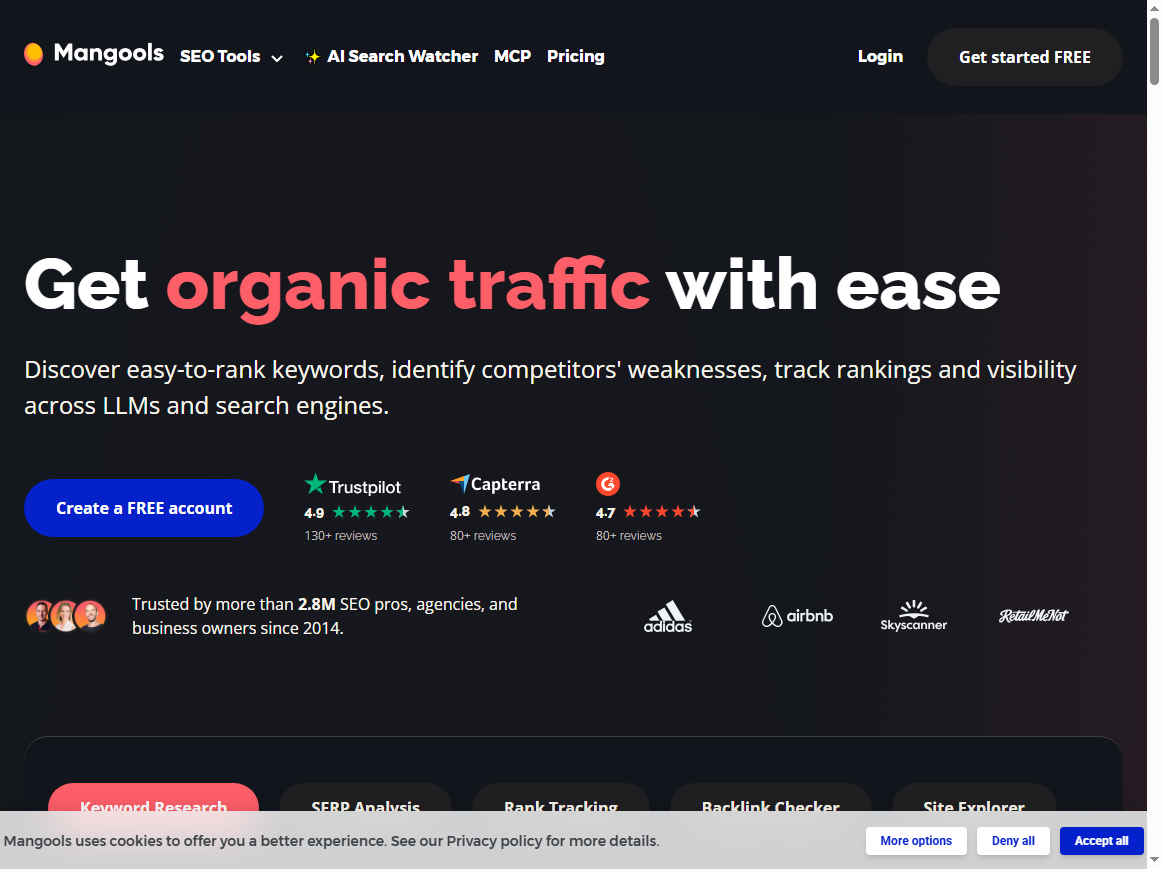
What Mangools covers
- Demand research: keyword discovery with difficulty scores, so you can pick phrases a small site can realistically win.
- SERP reading: see whether a query rewards articles, service pages, or directories before you write.
- Position tracking: daily movement for a defined keyword set, which is how you learn whether content is working.
- Link research: identify who links to the page outranking you, then build a realistic outreach list.
- Domain overview: a fast snapshot of a competitor’s visibility footprint.
What ClickFunnels covers
- Page building: landing pages, opt-ins, order forms and upsells assembled without a developer.
- Checkout and upsell flow: the post-purchase sequence that lifts average order value.
- Split testing: comparing page variants on conversion rather than opinion.
- Email and follow-up integration: connecting a lead to a nurture sequence.
- Campaign structure: a defined path from ad or link to purchase.
The cost of choosing wrong
Buy a funnel builder first when you have no traffic: you will build a beautiful path from an empty room. Buy a keyword tool first when your landing pages convert poorly: you will send more people into the same leak.
Both mistakes are common and both are expensive, because the subscription is the small cost — the wasted months are the real one. A simple diagnostic helps: check whether your problem is impressions or conversion rate. If almost nobody sees your pages, it is a traffic problem. If people see them and leave, it is a funnel problem.
Sequencing them sanely
Start with research. Pick five phrases with real demand and tolerable difficulty, publish pages that answer them properly, and track positions. Once a page receives steady visitors, build a focused funnel for that specific offer rather than a generic one for the whole site.
This order keeps you from optimising copy for an audience that never arrives, and it gives the funnel builder a real page with real intent behind it. It also keeps spend honest: each tool is justified by a measured problem, not by a launch-day impulse.
A worked sequence for a small business
Month one: research ten phrases around one service, publish three pages that answer them better than the current results, and start tracking. Month two: review which page attracts visitors, then build a single funnel around that offer with one clear action. Month three: split test the headline, not the whole page.
This sequence works because each step produces the input the next step needs. Research produces pages; pages produce traffic; traffic produces enough data to justify a funnel test. Skipping ahead means testing variants against an audience too small to distinguish real differences from noise.
Frequently asked
Does ClickFunnels help SEO?
Indirectly. Faster, clearer pages can improve engagement, but a funnel builder does not provide keyword research or rank tracking.
Can I run funnels on my existing site?
Often yes, using your CMS plus a form and checkout integration. A dedicated funnel tool is worth it when you need upsells and testing in one workflow.
Which should a beginner learn first?
Research. Understanding what people search for improves every page you build, funnel or not.
Verdict
For a site with content and no conversion path, ClickFunnels is the missing piece. For a site with an offer and no visitors, Mangools is. Most small businesses eventually need both, but almost none need both on day one.
Can Mangools build landing pages?
No. It researches and tracks; page building happens in your CMS or a funnel tool.
Do I need ClickFunnels if I use WordPress?
Not necessarily. A well-built WordPress page with a clear offer can convert. Funnel tools earn their place when you need checkout, upsells, and testing in one place.
Try Mangools yourself. A free account lets you test KWFinder and SERPChecker on your own keywords before you commit. Start with Mangools
This link does not change the price.
For the complete tool-by-tool breakdown, read our Mangools review.
Leave a Reply