Independent analysis. This page may contain affiliate links.
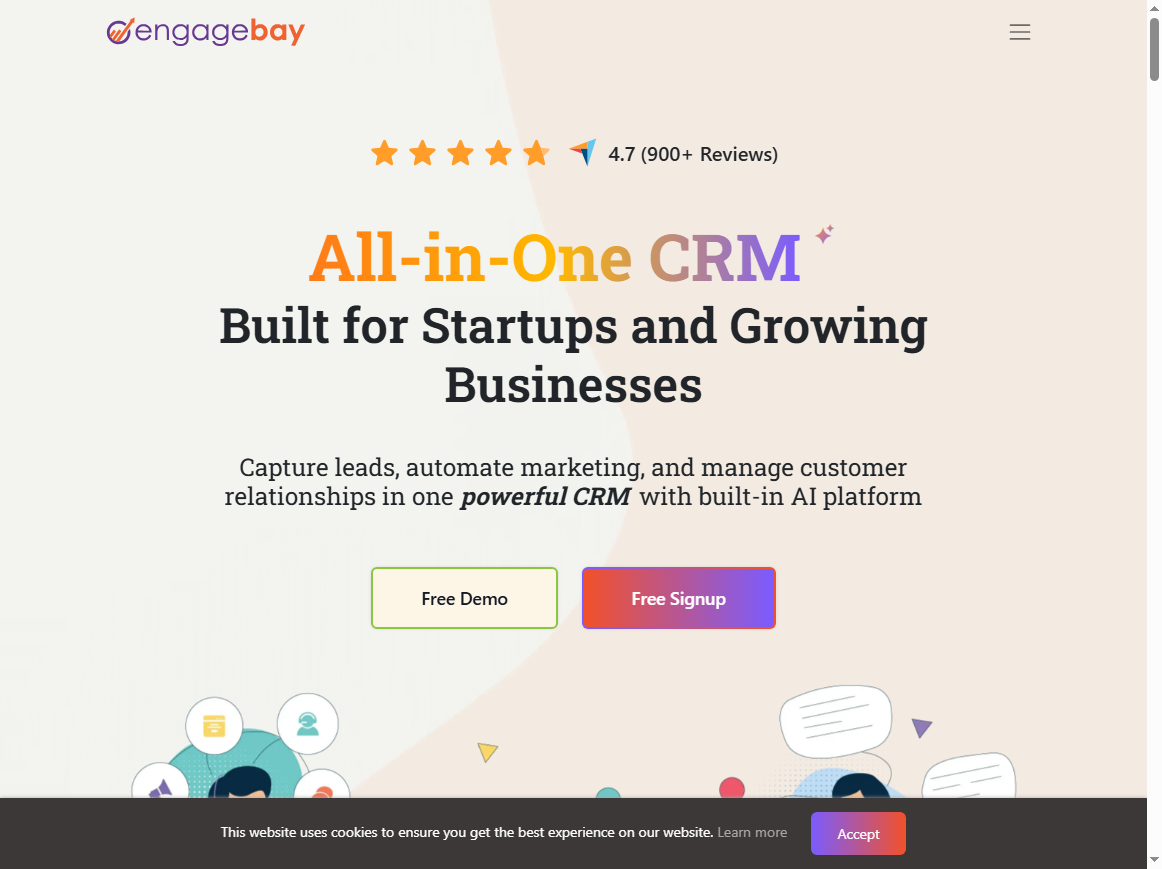
EngageBay is a CRM suite: contacts, pipelines, email campaigns, automation, and support. ClickFunnels is a funnel builder: landing pages, order forms, upsells, and checkout. They meet in the middle, where a landing page captures a lead that then needs nurture. If you already have pages and checkout, EngageBay is the missing layer. If you have no sales path, ClickFunnels comes first.
Two different centres of gravity
EngageBay is organised around the contact record. Every feature exists to move a person through a relationship: capture, segment, email, sell, support. Pages are a means, not the product.
ClickFunnels is organised around the page and the transaction. Its energy goes into templates, order bumps, upsells, and conversion mechanics. The contact record exists mainly to complete a purchase.
Where each one is strong
EngageBay is stronger for nurture: long sequences, segmentation, pipeline management, and a support inbox. If your sale takes weeks and involves conversations, that is the tool that matches reality.
ClickFunnels is stronger for a direct-response offer: a clear promise, a page, a price, an upsell. If you can sell in one session, funnel mechanics will move the number more than CRM depth.
The overlap that confuses buyers
Both can host a landing page and collect an email. That overlap makes them look comparable in a feature table, and it is the least important part of either product.
Ask what happens after the email is captured. If the answer is a sequence, a call, and a pipeline, the CRM matters more. If the answer is another page and a checkout, the funnel builder does.
Running both without duplication
The sane split is ClickFunnels for acquisition pages and checkout, EngageBay for contact records, nurture, and support. Connect them so a purchase creates or updates the contact.
Then define which system owns email. Sending campaigns from both is how people receive the same offer twice in a week and unsubscribe.
A cheaper path for simple offers
Many small offers do not need a funnel builder at all: a landing page, a payment link, and a three-email sequence can outperform an elaborate funnel because it is simpler to maintain.
If that describes you, start with the CRM and a plain page. Add funnel mechanics when you have traffic and a proven offer, not before.
Before you decide
Watch the renewal maths carefully. Two subscriptions that each feel reasonable can quietly exceed the margin of a small offer, especially when the funnel is not yet converting.
Start with the cheaper of the two that unblocks you, prove the offer, then add the second when the volume justifies it.
What to measure after thirty days
For the funnel, measure conversion at each step and the revenue per visitor. For the CRM, measure response time to new leads and how many open deals have a next step.
Those four numbers tell you which tool is actually earning its subscription. If neither moves, the problem is the offer, and no amount of tooling will fix an offer nobody wants.
What to do next
- Write down what happens after a lead opts in.
- If it is nurture and conversations, prioritise the CRM.
- If it is a checkout and upsell, prioritise the funnel.
- Connect the two so purchase data reaches the CRM.
- Choose one system to own outbound email.
The bottom line
One manages the relationship, the other manages the transaction. Pick based on which is missing, and connect them only when both are genuinely needed.
If you cannot describe what happens after the opt-in in one sentence, fix that before buying either.
Try EngageBay – the all-in-one CRM that covers marketing, sales and support without stacking subscriptions.
This link does not change the price.
For the full breakdown of modules, limits and alternatives, read our EngageBay review.
Frequently asked questions
Can EngageBay replace ClickFunnels?
For landing pages and lead capture, partly. For order forms, upsells, and checkout, no.
Do I need both?
Only if you sell direct-response offers and also run a longer sales conversation. Many businesses need one, not two.
Which is better for a course business?
Funnel mechanics usually drive the initial sale; the CRM handles the buyers afterwards. Courses often benefit from both.
Leave a Reply