Home / Guides / Course platforms
Course Platforms for Creators
Quick answer. In short: the best online course platforms for a small business balance price, ease of use and support. For most teams Thinkific is a solid starting point, but a second option often fits specific workflows better. Compare two or three options below before you commit.
Where to host and sell courses, compared on fees, features and how much control you keep over your audience.
Disclosure: ICode is an independent publisher. Where a page contains affiliate links we may earn a commission at no extra cost to you. See our Affiliate Disclosure.
Which path fits you?
Course platforms differ mostly on fees, learner experience and how much marketing they bundle. Find your situation below.
“I am selling my first course”
Keep it simple and cheap: a flat-fee platform with good basics. Our planned best course platforms round-up starts here.
“I want course basics done well”
Our planned Thinkific review looks at a focused course platform without the all-in-one price tag.
“I want a premium experience”
Community, coaching and polished delivery point to a heavier suite. Our planned Kajabi review covers when the higher price pays back.
“Fees are eating my margin”
A percentage per sale adds up fast. Start with the buying criteria below before you switch platforms.
What we cover in this section
Fees & revenue share
Marketplace reach versus your own-brand platform.
Course features
Drip, quizzes, certificates and communities.
Ownership
Who owns the customer relationship and the email list.

What “course platforms” actually covers
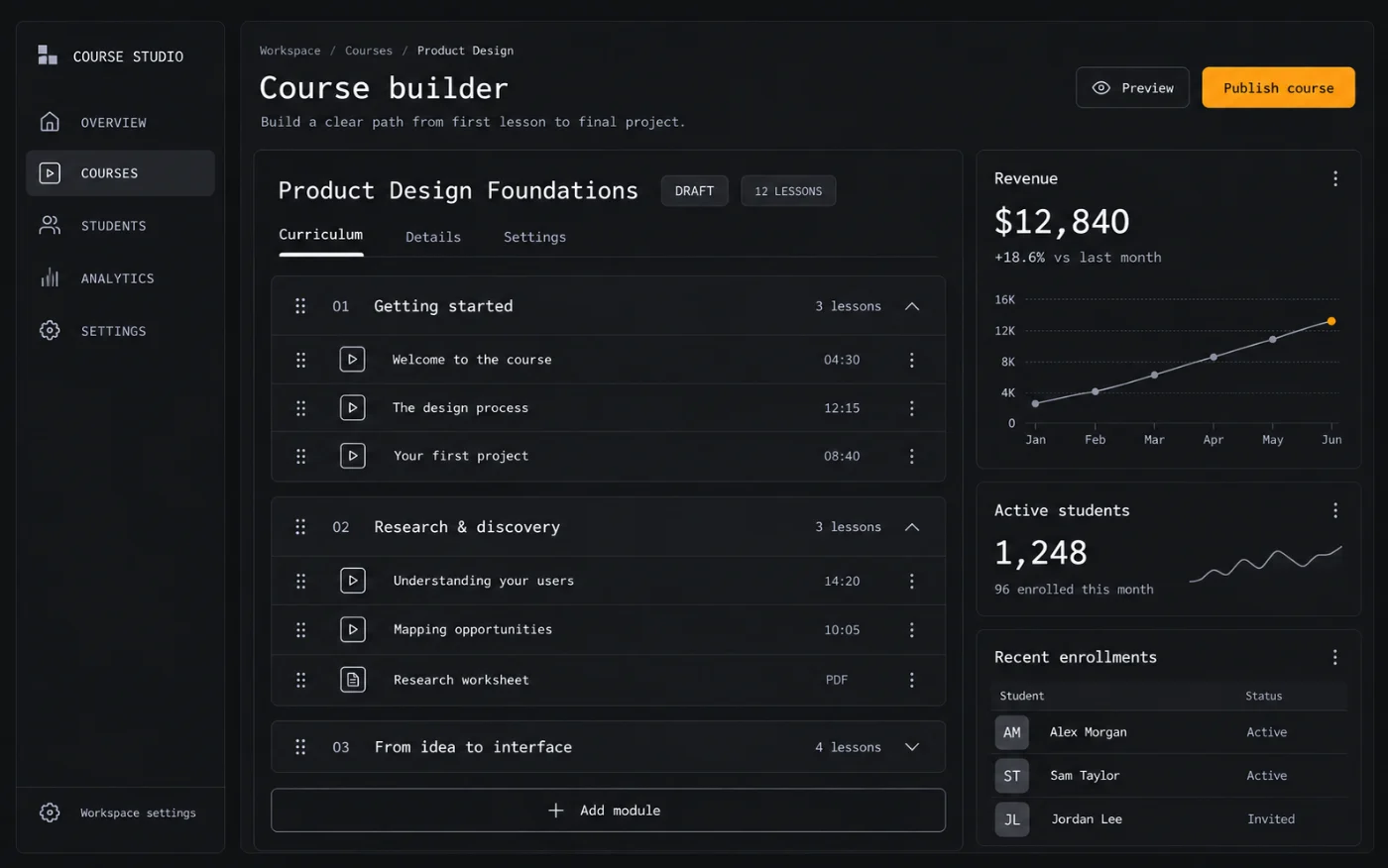
A course platform hosts your lessons, controls who can watch them and takes the payment. Around that core it may add drip schedules, quizzes, certificates, a community and email marketing. The two words that trip people up most are “marketplace” and “fees”, so they are worth separating before you compare anything else.
A marketplace lends you its audience but keeps a share of every sale and controls the relationship with students. Your own platform on your own domain keeps the margin and the customer list, but you bring the traffic. Most small creators are better served by the second model, and the pricing model of the platform — flat fee versus percentage — decides how that scales.
How to choose, in order of impact
- Fees and revenue share — a flat monthly fee and a per-sale percentage can cost very different amounts at the same revenue.
- Course mechanics — drip content, quizzes, certificates, prerequisites and how easily lessons are updated.
- Student experience — video hosting, mobile playback, progress tracking and whether a community is included.
- Marketing and upsells — email, bundles, coupons and whether you can sell beyond a single course.
- Ownership — your domain, your student data, and how portable a course would be if you moved.
Common mistakes
- Confusing a marketplace listing with an owned platform, then losing margin and customer data.
- Overlooking a per-sale fee that quietly grows with revenue.
- Paying for an all-in-one suite when a simple host plus your existing email tool is enough.
- Starting a community you cannot sustain because the plan includes one.
Buying criteria
- Revenue share — % taken versus flat monthly.
- Ownership — do you own the student list?
- Learning features — drip, quizzes, certificates.
- Payments — currencies, tax and payouts.
- Migration — exporting content and students.

How we weigh course platforms
Fees and course mechanics decide whether a platform is affordable; experience and marketing decide whether it is worth staying. This is our own editorial framework, not a vendor score.
| Criterion | Weight | What we look at | Why it matters |
|---|---|---|---|
| Fees & revenue share | 25% | Monthly fee plus any percentage per sale; transaction and processing costs | The cost structure decides your margin at scale |
| Course & content features | 20% | Drip, quizzes, certificates, prerequisites, video hosting and storage limits | These are the day-to-day teaching tools |
| Student experience | 20% | Mobile playback, progress tracking, community, support for questions | Completion and word-of-mouth depend on it |
| Marketing & upsells | 15% | Email, bundles, coupons, affiliate tooling, checkout flexibility | Selling a second course is easier than finding new students |
| Ease of use | 10% | Time to publish a first course, editor quality, template design | Shipping beats perfecting |
| Ownership & export | 10% | Custom domain, student data access, content export, migration help | Your audience is the asset; keep it portable |
How to use the weighting
Score each platform 1 to 5 per row and total. If you are pre-revenue, weighting ease of use and low fixed cost higher makes sense. Once you sell consistently, the fee row should dominate, because a percentage you agreed to at zero sales becomes the most expensive line on your statement.
Frequently asked
What is an online course platform?
A course platform hosts and sells your online courses, handling video hosting, student access, payments and often marketing tools.
How do course platforms take payment?
Most charge either a flat monthly fee or a share of revenue; revenue-share plans lower the upfront cost but take a percentage of every sale.
Do I own my content on a course platform?
On most platforms you keep ownership, but hosting is tied to the subscription, so check export options and what happens if you leave before you move a large catalogue.
How does ICode evaluate course platforms?
We compare the same features for each – revenue model, learning tools, limits, payout options and student experience.
Featured reviews & guides
The deeper pages in this section, split by what you are trying to decide.
Reviews
- Thinkific review — focused course hosting without the all-in-one price.
- Kajabi review — premium courses, community and marketing.
Best-of
- Best course platforms — picks by course type and budget.
Related
- Funnel builders — when a course is sold through a funnel.
- Email marketing software — to keep and sell to your students.
Not sure which tool fits?
Start with the comparison that matches your workflow — no signup required.
Related software categories on ICODE: see our Social & creative hub.
People also ask
What are the best online course platforms?
In short: the best online course platforms for a small business balance price, ease of use and support. For most teams Thinkific is a solid starting point, but a second option often fits specific workflows better. Compare two or three options below before you commit.
What are the best online course platforms for small business?
The best online course platforms for a small business are usually the ones with predictable pricing and a clear free or low-cost entry point. For most teams Thinkific is a good starting point; compare two or three options before you commit.
How do I choose online course platforms?
Start from your workflow and budget, not the feature list. List your must-have jobs, test the top two tools on a free plan, and check how pricing scales as you grow. Our hub pages break each option down by use case.
Are there free options?
Several online course platforms offer a free tier or a trial. Free plans usually cap usage or seats, so use them to validate fit, then upgrade when a limit starts to cost you time.