Choosing between Make and Pabbly Connect? Here is a side-by-side look at pricing, strengths and fit, so you can pick the right one in a few minutes.
Make official site (image: make.com)
Independent analysis. This page may contain affiliate links. Some links here are referral links; if you sign up through one we may earn a reward at no extra cost to you, and it never changes what we recommend. See our Affiliate Disclosure.
TL;DR
Make is a better fit for teams that want visual control over complex workflows.
Pabbly Connect is a better fit for budget-conscious users with high task volume.
Pick Make when visual power at volume matters most to you.
Pick Pabbly Connect when flat-rate pricing matters most to you.
At a glance
Feature
Make
Pabbly Connect
Starting price
Free; paid plans from about $9/mo
Free; paid plans from about $16/mo
Free plan
Yes
Yes
Best for
teams that want visual control over complex workflows
budget-conscious users with high task volume
Standout strength
visual power at volume
flat-rate pricing
Main trade-off
Steeper learning curve than simpler tools
Smaller integration library
Make templates (image: make.com)
Make in brief
Visual, no-code automation for multi-step workflows.
Pros: Drag-and-drop scenario builder; Large app library plus HTTP and webhook modules; Cheaper than rivals at high operation counts
Cons: Steeper learning curve than simpler tools; Operations-based pricing can surprise you; Errors often need manual debugging
Choose Make if you are teams that want visual control over complex workflows, or you value visual power at volume.
Choose Pabbly Connect if you are budget-conscious users with high task volume, or you value flat-rate pricing.
You can also use both together: Make and Pabbly Connect connect through native integrations, so many teams run one for visual power at volume and the other for flat-rate pricing. Start with the one that matches your budget and workflow, and add the second when a clear gap appears.
There is no universal winner. Make leads on visual power at volume, while Pabbly Connect leads on flat-rate pricing. Match the tool to your budget and workflow.
Is Pabbly Connect cheaper than Make?
On published pricing, Make starts at free; paid plans from about $9/mo and Pabbly Connect starts at free; paid plans from about $16/mo. Always check current pricing and renewal rates.
Can I use Make and Pabbly Connect together?
Yes. Both offer integrations and APIs, so you can run them side by side and send data between them.
Knowledge · funnel builders · updated October 9, 2026
Systeme.io free plan explained: what you get and the limits
Systeme.io is unusual in offering a genuinely usable free plan. Here is what a free account lets you do, where the limits bite, and when it is worth upgrading.
Independent analysis. This page may contain affiliate links. If you sign up through a link on this page we may earn a reward at no extra cost to you, and it never changes what we recommend. We are an independent publisher and are not affiliated with, endorsed by, or an official partner of any tool mentioned. See our Affiliate Disclosure.
TL;DR
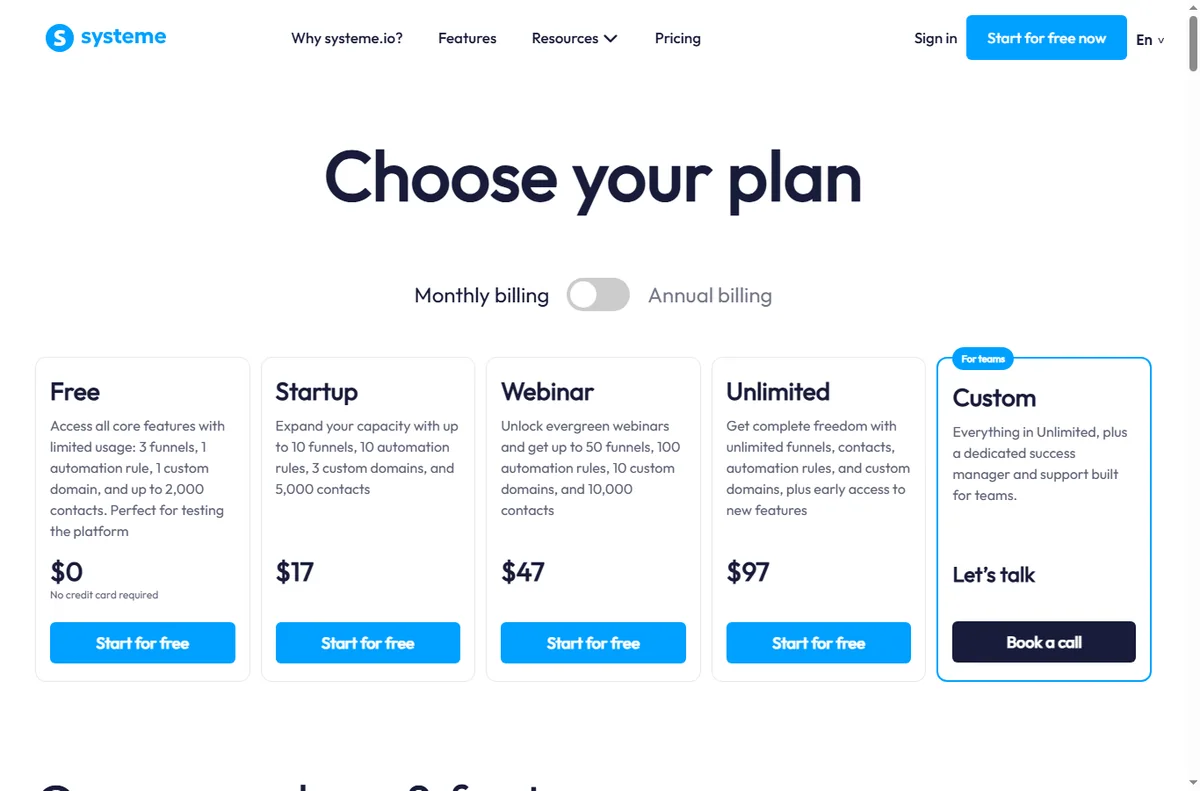
The free plan lets you build funnels, collect leads and sell, without a credit card.
The main limits are on contacts, emails and premium features rather than on whether you can launch.
It is enough to validate an offer and learn the platform before you pay.
Upgrade when your list or your traffic outgrows the ceilings, not before.
Confirm the current limits and pricing on the official site — they change.
Most funnel builders ask for a card before you can build anything. Systeme.io takes the opposite approach: its free plan lets you create funnels, capture leads and run a basic business without paying up front.
That makes it a useful way to learn the workflow and test an idea before you commit. The free plan is real, but it is a starting tier, not a finished business — the limits are deliberate and worth understanding. The plan is a genuine starting tier, not a disguised trial, so it is worth knowing exactly where the ceiling sits before you build.
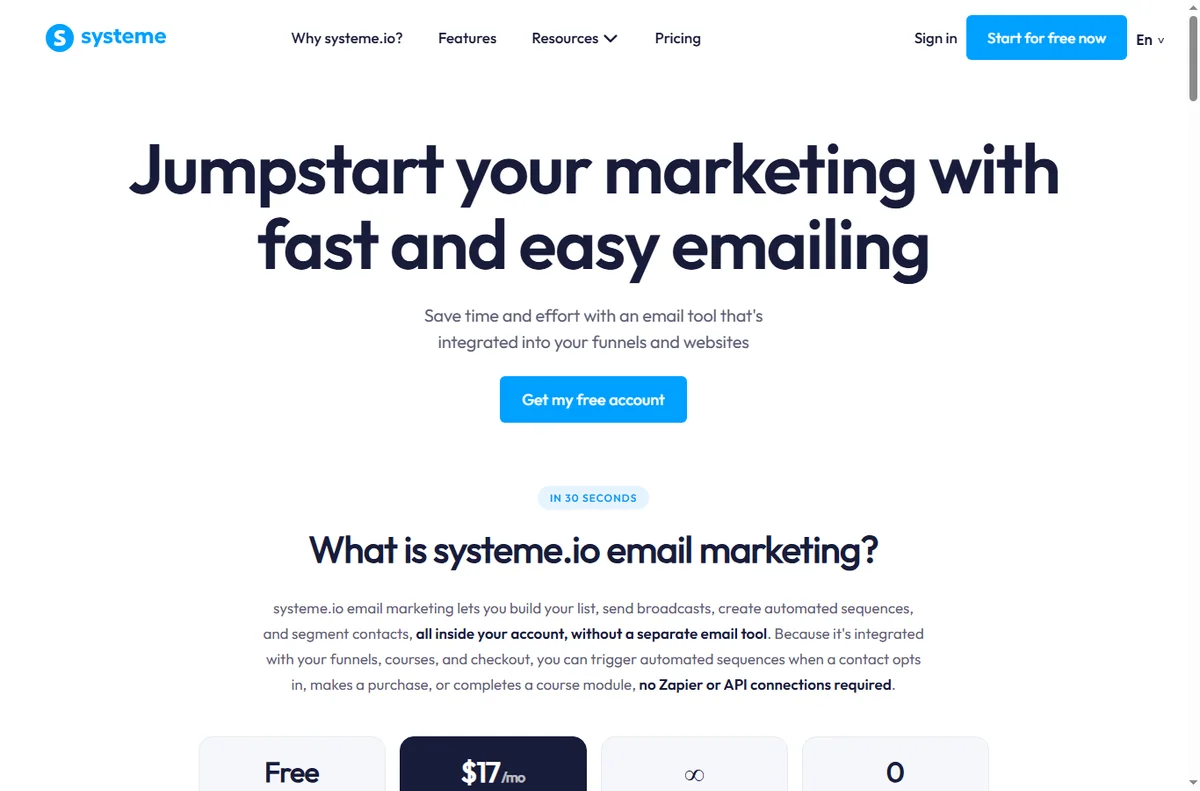
Systeme email marketing (image: systeme.io)
How the free plan works
You sign up, pick a funnel template and publish. The builder gives you landing pages, opt-in forms, an email list and basic automation in the same account as your course content.
Because everything lives in one place, there is no integration tax: no connectors to buy, no passwords to juggle. The catch is that the free tier caps how much you can send and how many contacts you can hold. In practice that means a beginner can run a real, if small, funnel and email campaign without a card on file.
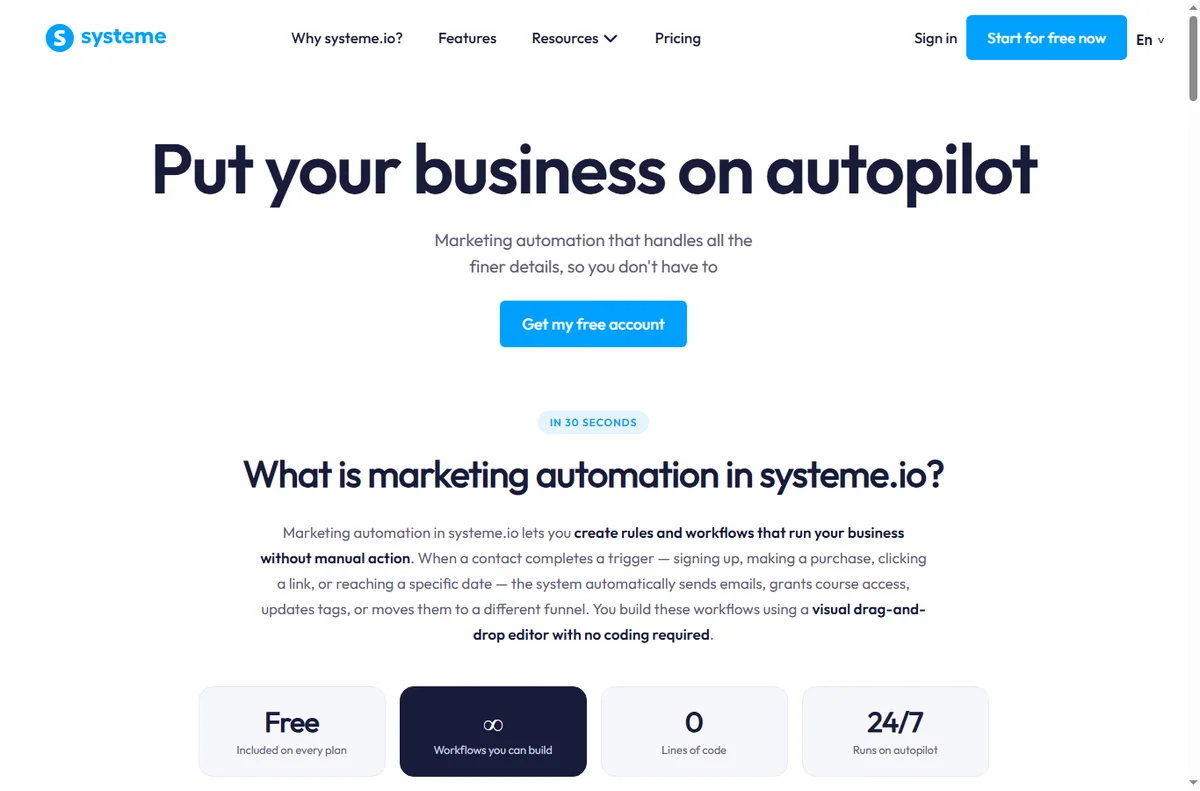
Systeme marketing automation (image: systeme.io)
What you get for free
Build and publish funnels and landing pages.
Collect leads and hold them in a built-in contact list.
Send emails to your list up to the plan limits.
Sell a product or course without a separate storefront.
Learn the whole platform before paying anything.
Systeme online courses (image: systeme.io)
Where the free plan stops
Contact and email limits that a growing list will hit.
Some premium features and higher capacity are paid-only.
Advanced automation and scale features sit on higher tiers.
Support and branding expectations differ from paid plans.
You will outgrow it once you market seriously — that is by design.
Key terms, plainly
Concept
Meaning
Why it matters
Free plan
A no-card starting tier with core funnel, email and course features.
Lets you validate an offer before you pay.
Contact limit
The number of leads your list can hold on the free tier.
The first ceiling a growing business hits.
Email limit
How many emails you can send within the plan.
Decides whether you can run real campaigns.
Upsell
Selling on the thank-you or checkout step.
Where growth-minded sellers earn more per lead.
Upgrade trigger
The moment the free limits slow you down.
Tells you when paying is genuinely worth it.
Plain-language terms only. Confirm exact limits on the official pricing page.
Systeme pricing (image: systeme.io)
Where this fits
The free plan fits anyone testing whether funnels and email marketing work for them, and anyone who wants to learn the platform without risk. If you are validating a course, a lead magnet or a first offer, it is enough to get real feedback. Once leads convert consistently and the limits start to slow you down, that is your signal to upgrade rather than a sign something is wrong. For the paid tiers and what they add, see the Systeme.io pricing guide, and for the bigger picture read our Systeme.io review.
Systeme register (image: systeme.io)
Frequently asked
Is the Systeme.io free plan really free?
Yes — you can build and launch without paying, and no card is required to start. The trade-off is limits on contacts, emails and premium features. Check the current limits on the official site.
What are the main limits?
The free plan caps your contacts and email sending, and reserves some advanced features for paid tiers. For most beginners those limits are generous enough to validate an offer.
When should I upgrade?
Upgrade when the limits actually slow you down — when your list outgrows the contact cap or you need premium automation. Upgrading before then just spends money you do not need to spend yet.
Can I sell courses on the free plan?
You can start selling with the free account, within its limits. Heavy course or membership businesses will want a paid tier for capacity and features.
Start free, upgrade only when you grow
No card needed to build your first funnel. Check the current limits on the official site.
Some links on this page may be referral links — we may earn a reward if you sign up, at no extra cost to you. We are an independent publisher. See our Affiliate Disclosure.
Comparison · funnel builders · updated October 9, 2026
Systeme.io vs Kartra: pricing, features and who should pick each
Systeme.io and Kartra are both all-in-one marketing platforms, so the comparison is closer than it looks. Here is how they differ on features, commitment and the type of creator each one suits.
Independent analysis. This page may contain affiliate links. If you sign up through a link on this page we may earn a reward at no extra cost to you, and it never changes what we recommend. We are an independent publisher and are not affiliated with, endorsed by, or an official partner of any tool mentioned. See our Affiliate Disclosure.
TL;DR
Both bundle funnels, email and courses — so the choice is about depth, commitment and fit.
Systeme.io is the simpler, lower-entry all-in-one; Kartra leans into memberships and campaign depth.
If memberships and video are central, look closely at Kartra.
If you want the easiest all-in-one starting point, Systeme.io is usually the lighter lift.
Check the current pricing on both sites — plans are revised regularly.
Because both platforms are all-in-one, we compared them on the features that separate a hobby project from a business: membership and video support, campaign automation, course delivery, and how quickly a beginner can launch.
We do not quote specific prices here. Both vendors restructure tiers regularly, so the honest answer is to check the current pricing and match a tier to your usage. The goal is to pick the platform you will still be happy with at your next growth stage, not the one with the longest checklist.
Systeme email marketing (image: systeme.io)
At a glance
Aspect
Systeme.io
Kartra
Positioning
Simple all-in-one
Premium all-in-one
Funnels
Yes
Yes
Email + automation
Yes
Yes, advanced campaigns
Memberships / video
Courses, lighter video
Strong memberships and video
Learning curve
Gentle
Moderate
Pricing
Check the current pricing
Check the current pricing
Emphasis comparison. Verify current features and plans with each vendor.
Systeme marketing automation (image: systeme.io)
Where Systeme.io fits
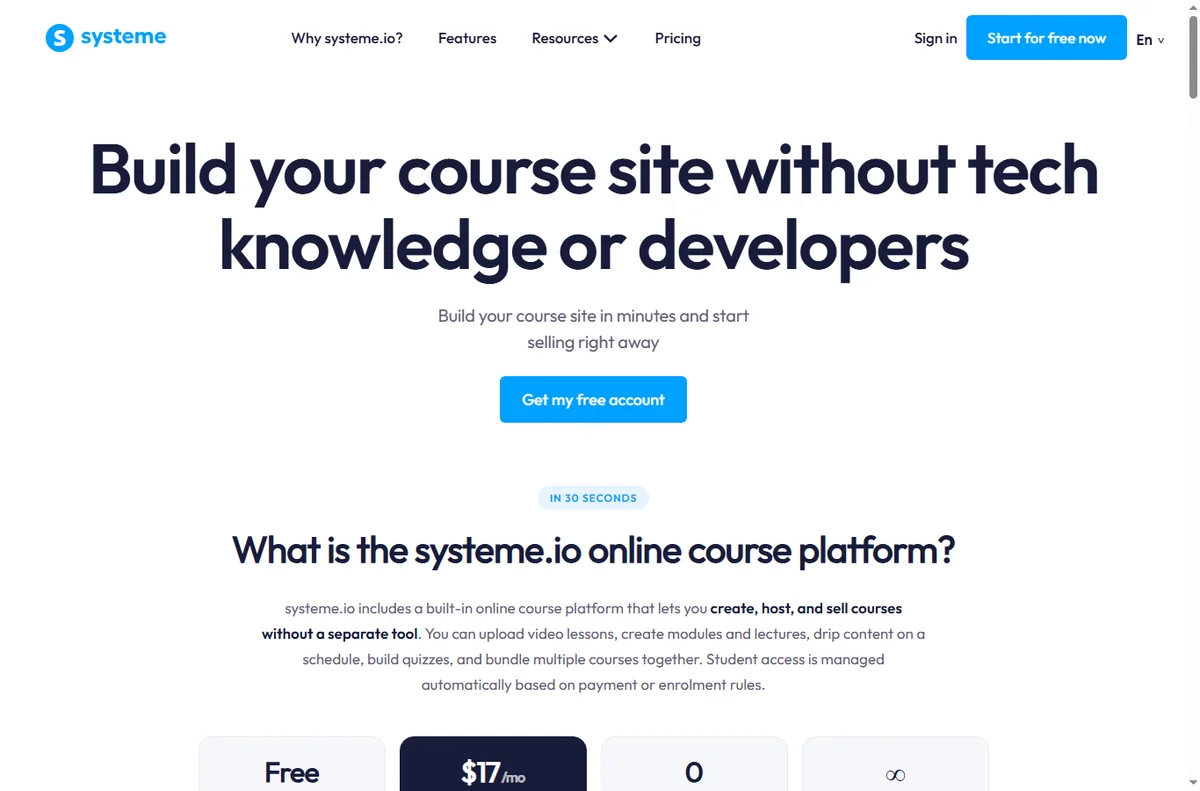
Systeme.io aims to give you the whole toolkit without a steep bill or a steep learning curve. Funnels, email, automation and courses live in one account, which makes it a natural first platform for a solo marketer or small team.
It is the friendlier starting point if you are still proving the offer. Our Systeme.io review and pricing guide cover the specifics.
Where Kartra fits
Kartra targets creators who want a premium, everything-under-one-roof platform with strong membership sites, video hosting and detailed campaign logic. If your business is built around a paid membership or a media library, that depth is valuable.
It usually asks for more commitment — in budget and in learning time — so it rewards creators who will genuinely use the membership and automation depth. See our Kartra overview.
Systeme online courses (image: systeme.io)
Features that decide it
Strip away the marketing and a few features usually decide the choice: how central memberships and video are, how much automation you actually build, and whether you need a big template library.
If you mainly need a funnel plus email plus a simple course, Systeme.io covers it. If you run a membership business with video at its core, Kartra is built for that pattern.
Cost and commitment
Treat the decision as a commitment question rather than a sticker-price question. An all-in-one only pays off if you use most of the stack; otherwise you are paying for features you ignore.
Match each tier to the modules you will use this quarter, then re-check the current pricing before you buy.
Systeme pricing (image: systeme.io)
Who should pick each?
Pick Systeme.io if you want the simplest, lowest-commitment route to an all-in-one stack — funnels, email and courses in one place — and you would rather start light and grow. Pick Kartra if memberships, video and advanced campaigns are central to your business and you are ready for a heavier platform.
Both are capable; the deciding factor is usually the kind of business you run, not a single feature.
A useful rule: if you cannot name three features on the higher tier that you will use every week, you are buying capability rather than results. Start where you will actually work, and revisit the choice after a quarter of real use.
Solo founder or small team starting out: Systeme.io.
Membership or video-led business: Kartra.
Unsure? Start on the lighter platform and migrate when memberships become central.
Systeme register (image: systeme.io)
Frequently asked
Is Kartra better than Systeme.io?
Neither is better outright. Kartra goes deeper on memberships and campaigns; Systeme.io is simpler and lighter to start. Compare the current plans against your workflow.
Do both include email marketing?
Yes, both include email marketing. Kartra emphasises advanced campaign automation, while Systeme.io keeps email, funnels and courses in one straightforward account.
Which is easier for beginners?
Systeme.io generally has the gentler learning curve, partly because it keeps the interface and the stack simpler. Kartra rewards users who take time to learn its depth.
Do either offer a free plan?
Systeme.io has a free plan with limits; Kartra does not. Always check the current pricing and limits before deciding.
Compare both before you commit
Start on the free option and upgrade only when you outgrow it.
Some links on this page may be referral links — we may earn a reward if you sign up, at no extra cost to you. We are an independent publisher. See our Affiliate Disclosure.
Comparison · funnel builders · updated October 9, 2026
Systeme.io vs ClickFunnels: which funnel builder fits you?
Quick answer. In short: choose Systeme.io for value and a free tier, and ClickFunnels for polish and advanced funnels. For most small teams Systeme.io is the quicker start, while ClickFunnels rewards heavier workflows. Both are capable tools; the right answer depends on your budget and how much setup you can tolerate.
Both tools build sales funnels, but they aim at different budgets and skill levels. Here is a straight comparison of features, ease of use and who each one actually suits.
Independent analysis. This page may contain affiliate links. If you sign up through a link on this page we may earn a reward at no extra cost to you, and it never changes what we recommend. We are an independent publisher and are not affiliated with, endorsed by, or an official partner of any tool mentioned. See our Affiliate Disclosure.
TL;DR
Systeme.io is an all-in-one stack: funnels, email and courses in one account, easy to start.
ClickFunnels is a dedicated funnel builder with deeper control and a bigger template library.
If you want one account and a low entry point, Systeme.io is simpler.
If you run complex, high-traffic funnels and want fine control, ClickFunnels goes deeper.
Both revise pricing regularly — confirm the current plans on each site.
We judged both tools on the same four questions: how quickly you can launch a first funnel, how much is included versus added on, how steep the learning curve is, and how easy it is to keep costs predictable as you grow.
We deliberately do not quote price figures, because both vendors change plans often. Use the links to check the current pricing instead of relying on outdated numbers.
Systeme email marketing (image: systeme.io)
At a glance
Aspect
Systeme.io
ClickFunnels
Core focus
All-in-one funnels, email and courses
Advanced funnel building
Learning curve
Gentle
Moderate to steep
Email marketing
Built in
Limited / separate tool
Online courses
Built in
Add-on or separate
Free option
Free plan available
No free plan
Pricing
Check the current pricing
Check the current pricing
Summary of emphasis only. Features and plans change — verify with each vendor.
Systeme marketing automation (image: systeme.io)
Where Systeme.io fits
Systeme.io is built to remove tool sprawl. You can build the funnel, send the emails that follow up, and host a course, all inside one account with one login and one bill. For a first funnel or a side business, that reduces both cost and confusion.
The free plan lets you learn the workflow before paying anything, and the paid tiers scale as your list grows. See the Systeme.io review and pricing guide for details.
Where ClickFunnels fits
ClickFunnels is for people who treat funnels as the product. It offers deep control over each step, a large library of proven templates and the flexibility to build complicated offer sequences. Teams spending real money on traffic often value that control.
The cost of that depth is complexity and a separate email or course stack. If you are early, that overhead can slow you down before you have traffic to optimise.
Systeme online courses (image: systeme.io)
Cost and scaling
The simplest way to decide is to plan for growth. If you expect to grow your list, launch courses and run several funnels, an all-in-one like Systeme.io keeps the stack and the bill simple. If your revenue depends on squeezing more from high-traffic funnels, ClickFunnels is designed for that scale.
Never compare from memory: open both pricing pages side by side and match each tier to what you will actually use.
Support, templates and community
ClickFunnels has a large, established community and a deep template catalogue. Systeme.io leans on an in-house education and template library that is well suited to beginners.
If you learn best from a big community, ClickFunnels has more of it. If you want guided, simpler onboarding, Systeme.io usually gets there faster.
Systeme pricing (image: systeme.io)
Which should you choose?
Pick Systeme.io if you want the fastest, cheapest route to a complete funnel with email and courses included, and you value simplicity over maximum control. Pick ClickFunnels if you are already running funnels at volume and need the deepest possible control over each step.
There is no wrong answer for the right stage: the mistake is buying depth you will not use, or hitting a ceiling you did not plan for.
First funnel, tight budget, want email and courses included: Systeme.io.
Established traffic, complex offer sequences, want fine control: ClickFunnels.
Unsure? Start on the free or lowest tier and upgrade when you outgrow it.
Systeme register (image: systeme.io)
Frequently asked
Is Systeme.io better than ClickFunnels?
Not universally. Systeme.io is a simpler all-in-one that suits most small businesses; ClickFunnels is deeper for high-volume funnel teams. Compare the current plans and your own workflow.
Does ClickFunnels include email marketing?
ClickFunnels is primarily a funnel builder, so email is limited or handled by a separate tool. Systeme.io includes email in the same account.
Can I switch later?
Yes. Both let you export your list, and funnels can be rebuilt. Start on the tool that matches your stage and migrate when it no longer fits.
Does Systeme.io have a free plan?
Yes, there is a free plan with limits. Check the current pricing and limits on the official site before you commit.
Some links on this page may be referral links — we may earn a reward if you sign up, at no extra cost to you. We are an independent publisher. See our Affiliate Disclosure.
In short: choose Systeme.io for value and a free tier, and ClickFunnels for polish and advanced funnels. For most small teams Systeme.io is the quicker start, while ClickFunnels rewards heavier workflows. Both are capable tools; the right answer depends on your budget and how much setup you can tolerate.
Systeme.io vs ClickFunnels: which is better?
Systeme.io is better for value and a free tier; ClickFunnels is better for polish and advanced funnels. Most small teams should pick based on which of those two matches their workflow, then check current pricing.
Can I switch later?
Yes. Both Systeme.io and ClickFunnels let you export and re-import data, though migration always takes some effort. Starting on the cheaper plan and moving when you outgrow it is a common, low-risk path.
Which is cheaper?
Pricing changes often, so check each provider directly. In general the two are close at entry level; costs diverge once you add seats, contacts or higher usage tiers.
Comparison · funnel builders · updated October 9, 2026
Systeme.io alternatives: 7 tools compared (2026)
Systeme.io bundles funnels, email and courses into one account — but it is not the only tool that does. Here are seven alternatives worth comparing, and how to choose between them without overpaying.
Independent analysis. This page may contain affiliate links. If you sign up through a link on this page we may earn a reward at no extra cost to you, and it never changes what we recommend. We are an independent publisher and are not affiliated with, endorsed by, or an official partner of any tool mentioned. See our Affiliate Disclosure.
TL;DR
Systeme.io wins on all-in-one simplicity; ClickFunnels and Kartra lean harder into advanced funnel and membership features.
Leadpages is page-first, Kajabi and Thinkific are course-first, and GetResponse leans on email.
Choose by the job you do most often, not by the longest feature list.
Most tools offer a trial or free tier, so you can test the workflow before you commit.
Plans change often — check the current pricing on each vendor site before you buy.
We compared the tools on the parts that decide whether you actually finish a funnel: how easy the builder is to learn, whether email and automation are included, whether you can sell a course in the same account, and how transparent the pricing page is.
This is a feature-emphasis comparison, not a benchmark. We have not listed dollar amounts because plans are revised frequently; instead we point you to where to confirm the current pricing and limits.
At a glance
Tool
Best for
Funnels
Email + automation
Courses
Pricing
Systeme.io
All-in-one on a budget
Yes
Yes
Yes
Free plan; check the current pricing
ClickFunnels
Advanced, high-volume funnels
Yes
Basic
Add-on
Check the current pricing
Kartra
Funnels plus memberships
Yes
Yes
Yes
Check the current pricing
Leadpages
Fast, high-converting pages
Limited
Light
No
Check the current pricing
Kajabi
Premium course businesses
Light
Yes
Yes
Check the current pricing
Thinkific
Selling online courses
No
Light
Yes
Free plan; check the current pricing
GetResponse
Email-first marketing
Light
Yes
Yes
Free plan; check the current pricing
Feature emphasis only. Confirm current plans and limits on each vendor site before you buy.
Systeme email marketing (image: systeme.io)
1. Systeme.io: the all-in-one baseline
Systeme.io is the tool this guide starts from, so it earns first mention. It bundles funnel building, email marketing, a course builder and automation in one account, which removes the need to stitch three subscriptions together. For a solo founder or a small team, that single-account simplicity is the whole point.
Where it gives ground is depth: power users who need very granular funnel logic may reach its ceiling earlier. Read our full Systeme.io review and the pricing guide for the detail.
Systeme marketing automation (image: systeme.io)
2. ClickFunnels: depth for high-volume funnels
ClickFunnels is the name most people meet first in this category. It is strong at building elaborate, traffic-heavy funnels with a large template library and detailed control over each step. If funnels are your core business, the extra depth can matter.
The trade-off is that email and course features are less central, so many teams pair it with separate tools. See our ClickFunnels overview for where it fits.
3. Kartra: memberships and all-in-one marketing
Kartra competes in the same all-in-one space as Systeme.io. It is known for membership sites, video hosting and built-in campaign logic, and it suits creators who want a single dashboard for a membership business.
It typically sits at a higher commitment level, so it rewards creators who will use the membership and marketing depth rather than a single funnel. Our Kartra overview has the specifics.
Systeme online courses (image: systeme.io)
4. Leadpages: pages that convert quickly
Leadpages is page-first: landing pages, opt-ins and simple funnel steps. If your bottleneck is not the whole stack but the page that captures the lead, it is fast to launch and easy to learn.
It is not a full email or course platform, so it usually sits alongside other tools rather than replacing them.
5. Kajabi: premium course businesses
Kajabi targets established creators running premium courses and communities. It leans into course delivery, marketing and polished member experiences, and it is priced and positioned for businesses that already sell.
If you are still validating your first course, a lighter and cheaper starting point usually makes more sense.
6. Thinkific: course-first selling
Thinkific focuses on building and selling online courses with a gentle learning curve and a free starting tier. If courses are your product and funnels are secondary, it is a natural fit.
It offers limited funnel-building, so pair it with a page builder if you also run heavy funnels.
Systeme pricing (image: systeme.io)
7. GetResponse: email-first marketing
GetResponse started in email marketing and grew into landing pages, automation and course features. It suits businesses whose revenue engine is the email list rather than the funnel.
If email is the centre of your marketing, it is worth a close look; if courses and funnels are the centre, the all-in-one options above are usually simpler.
Which should you pick?
Start from the job you do most. If you want one account for funnels, email and courses at a low entry point, Systeme.io is the simplest place to begin. If you build complex, high-traffic funnels, ClickFunnels gives you more control. If memberships are the product, look closely at Kartra; if courses are the product, Thinkific and Kajabi are the course-first options.
Want everything in one account, cheap to start: Systeme.io.
Funnels are the business and you need depth: ClickFunnels.
Membership sites and campaigns: Kartra.
Pages only, fast to launch: Leadpages.
Premium course business: Kajabi.
Course-first with a free start: Thinkific.
Email-first marketing: GetResponse.
Systeme register (image: systeme.io)
Frequently asked
Is Systeme.io cheaper than ClickFunnels?
Pricing changes often, so compare the current plans on each site rather than trusting old figures. Systeme.io is generally the lower-commitment starting point, and it includes email and courses in the same account.
Can I use Systeme.io and another tool together?
Yes. Many teams run Systeme.io for funnels and courses while keeping a specialised email or page tool. The point of an all-in-one is that you usually do not have to.
Which alternative is best for beginners?
Look for a tool with a free or trial tier and a gentle builder. Systeme.io, Leadpages and Thinkific are all reasonable starting points depending on whether you sell funnels, pages or courses.
Do these tools have free plans?
Several do, including Systeme.io, Thinkific and GetResponse. Free plans usually carry limits, so check the current pricing and limits before you commit.
Start with a tool that fits your funnel
Compare the current plans and try the free options before you commit.
Some links on this page may be referral links — we may earn a reward if you sign up, at no extra cost to you. We are an independent publisher. See our Affiliate Disclosure.
Home / E-commerce / Guides / Common WooCommerce problems
Problem · e-commerce · updated October 9, 2026
Common WooCommerce problems and how to fix them
Most WooCommerce problems fall into a few areas: a checkout that will not complete, products that will not show or update, payments that fail, a store that is slow, and emails that never arrive. Here are the ones that come up most, and what to check first.
Independent analysis. This page may contain affiliate links. If you sign up through a link on this page we may earn a reward at no extra cost to you, and it never changes what we recommend. We are an independent publisher and are not affiliated with, endorsed by, or an official partner of any tool mentioned. See our Affiliate Disclosure.
TL;DR
A checkout that will not complete is usually a plugin or payment conflict.
Products that will not show are usually visibility, stock or caching.
Failed payments are often gateway settings or currency.
A slow store is usually hosting, caching or heavy plugins.
Missing order emails are usually SMTP or deliverability.
Some links on this page may be referral links — we may earn a reward if you sign up, at no extra cost to you. We are an independent publisher. See our Affiliate Disclosure.
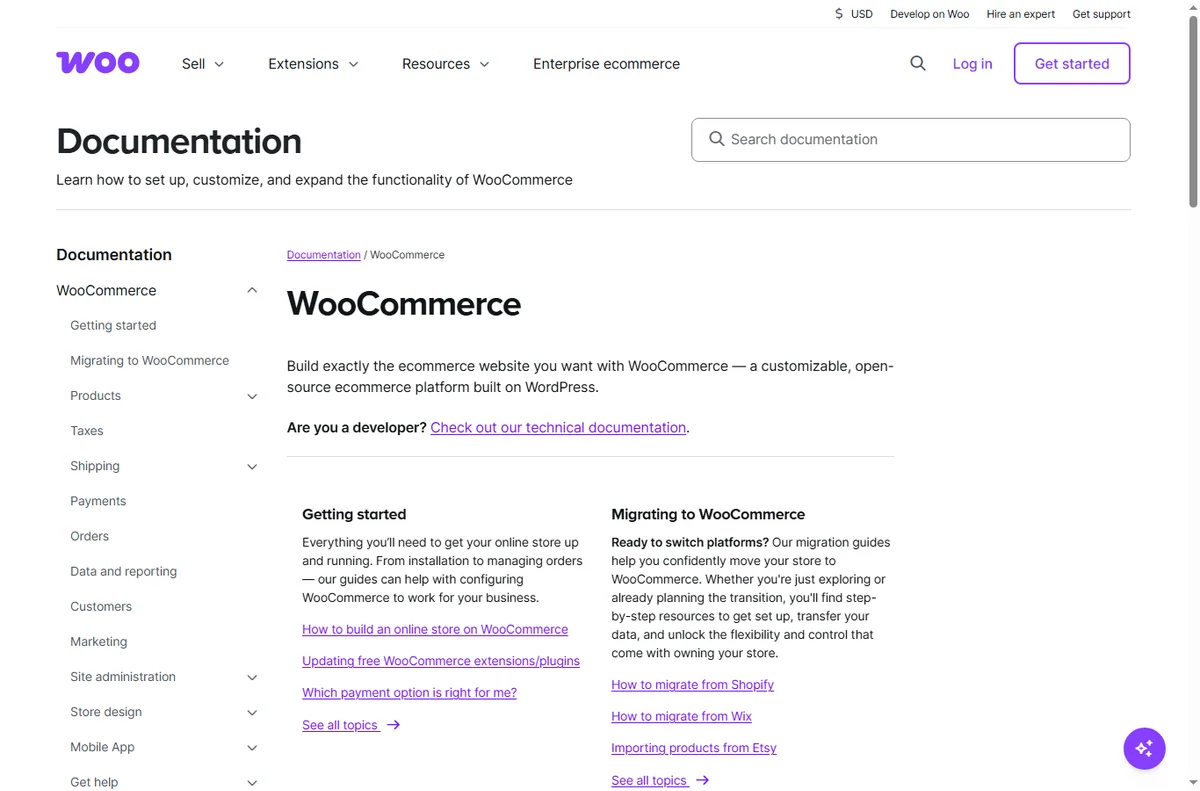
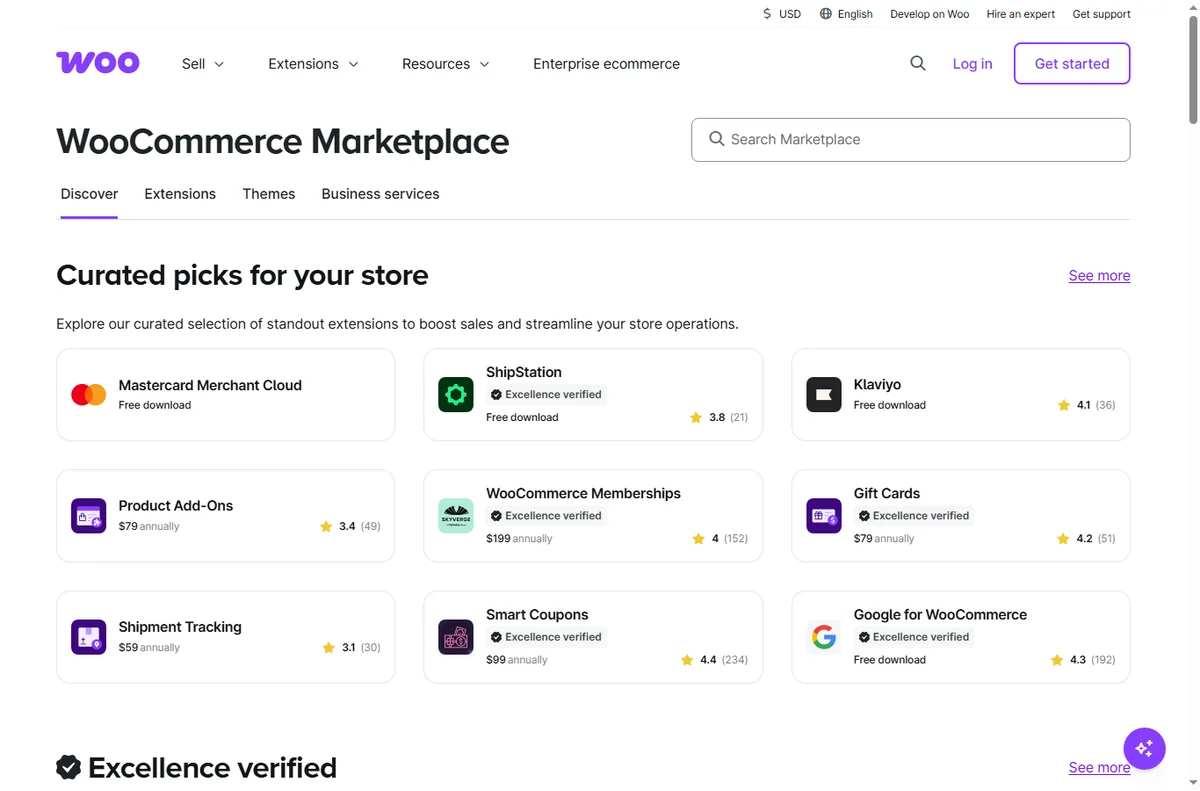
WooCommerce is a free, open-source e-commerce plugin that turns a WordPress site into an online store you own and control. This guide explains what it does, how it is organised, and what it is not.
Independent analysis. This page may contain affiliate links. If you sign up through a link on this page we may earn a reward at no extra cost to you, and it never changes what we recommend. We are an independent publisher and are not affiliated with, endorsed by, or an official partner of any tool mentioned. See our Affiliate Disclosure.
TL;DR
WooCommerce is an open-source e-commerce plugin for WordPress.
It turns an existing WordPress site into a store.
You own the store and the data; hosting and extensions are the real costs.
Features, extension terms and prices change, so check the current pricing before you commit.
It is not a hosted all-in-one platform: you still run hosting and updates.
Some links on this page may be referral links — we may earn a reward if you sign up, at no extra cost to you. We are an independent publisher. See our Affiliate Disclosure.
Problem · course platforms · updated October 9, 2026
Common LearnWorlds problems and how to fix them
Course platforms fail in small, specific ways, and the symptom rarely points straight at the cause. This guide covers the LearnWorlds issues that come up most and what to check first.
Independent analysis. This page may contain affiliate links. If you sign up through a link on this page we may earn a reward at no extra cost to you, and it never changes what we recommend. We are an independent publisher and are not affiliated with, endorsed by, or an official partner of any tool mentioned. See our Affiliate Disclosure.
TL;DR
Most LearnWorlds problems come from access rules, browser caches or a settings mismatch.
A student who cannot see a course is usually blocked by a membership rule, not a broken course.
Video and login issues are often browser or device specific.
Check the student view before you change the course itself.
When payments look wrong, compare the receipt with the access it grants.
On a course platform, a small misconfiguration shows up as a student complaint rather than an error message, which makes the cause harder to see.
Access rules, browser caches and a settings mismatch cover most of what goes wrong. Reproducing the problem from a student point of view usually narrows it down fast.
Work through the simple explanations before you rebuild anything.
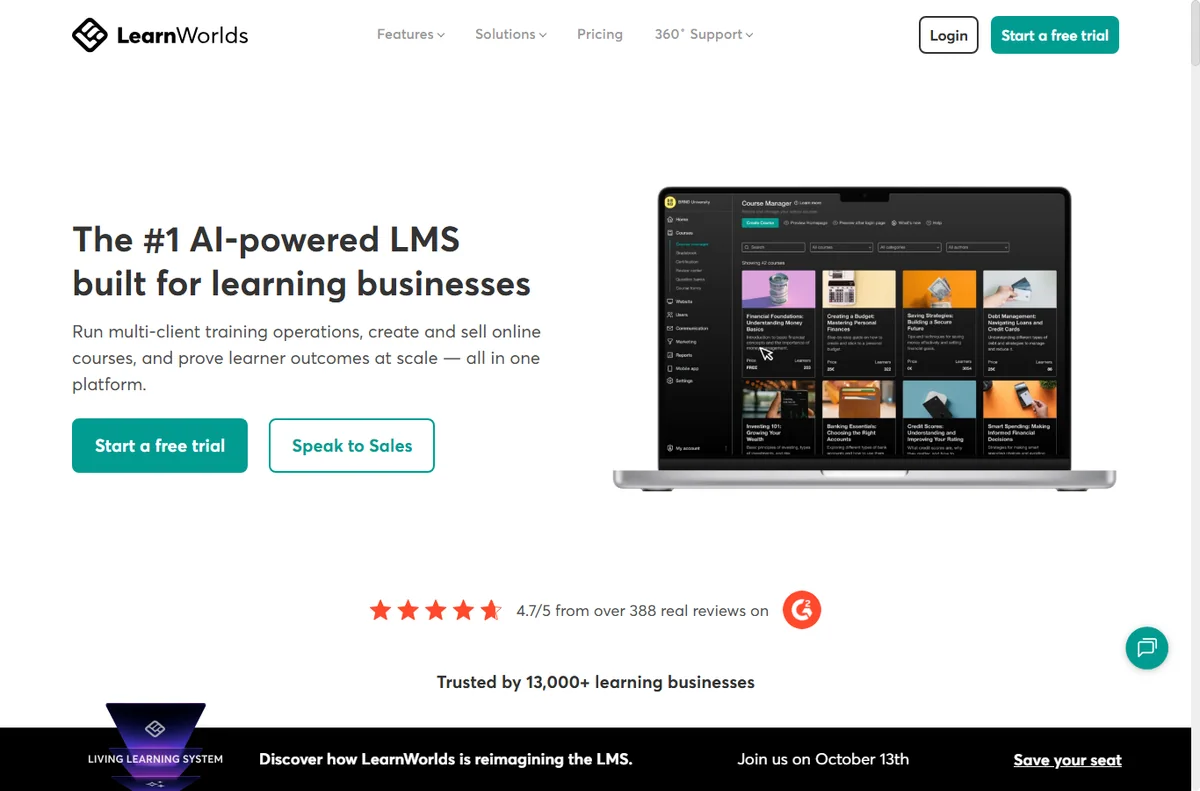
Learnworlds home (image: learnworlds.com)
Students cannot access a course
This is almost always an access rule rather than a fault with the lesson itself.
Check the membership that grants access.
Confirm the student account is enrolled.
Test with a fresh student account.
Learnworlds blog (image: learnworlds.com)
Videos will not play
Playback problems are usually browser, network or format specific rather than a platform failure.
Try another browser and device.
Check the network or a content blocker.
Confirm the lesson is published.
Login or password problems
A login that fails is often a caching or email delivery issue rather than a wrong password.
Have the student reset the password.
Check that the welcome email arrived.
Clear the browser cache before retrying.
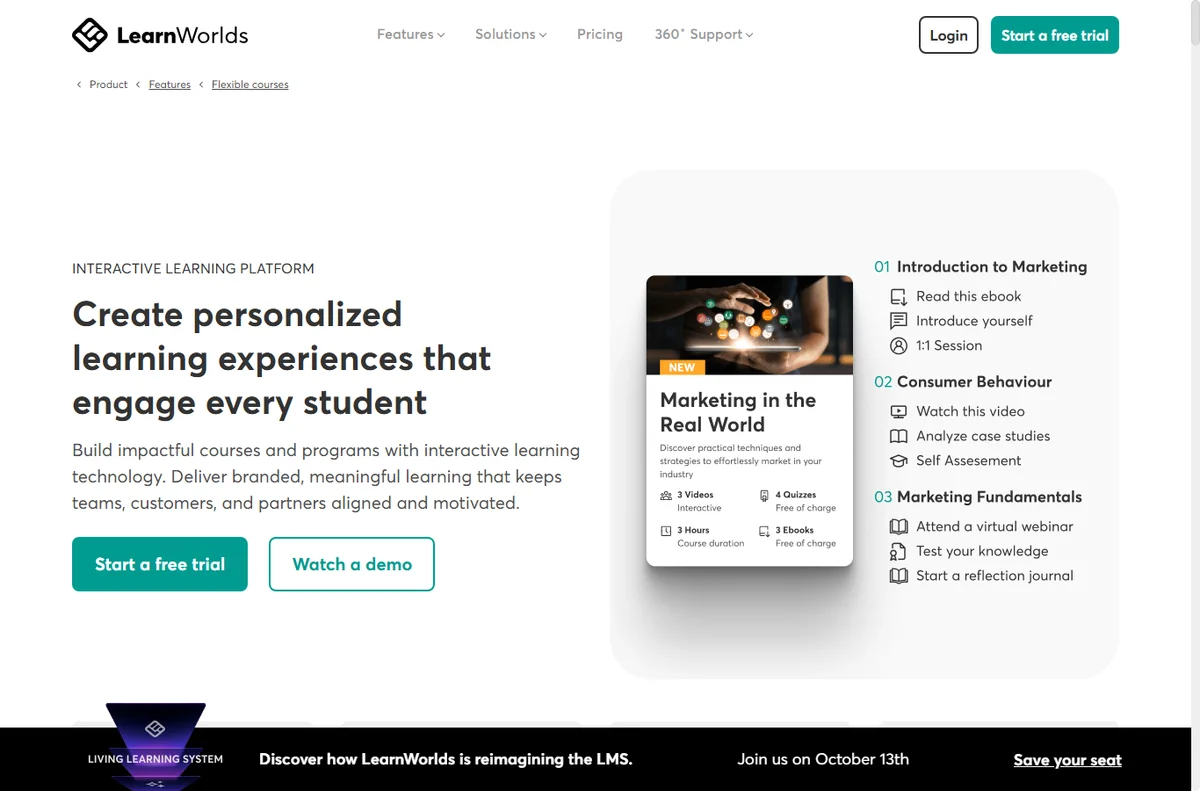
Learnworlds features (image: learnworlds.com)
Payments and access mismatch
When a sale does not unlock the course, the cause is usually a delayed notification or a mismatched product.
Confirm the payment completed.
Check the product the student bought.
Allow a short delay for access to sync.
Learnworlds integrations (image: learnworlds.com)
Custom domain or page issues
A custom domain that will not resolve, or a page that looks broken, is usually a DNS or cache problem.
Verify the DNS records.
Clear the cache layer.
Re-save the page settings.
Symptom to fix
Symptom
Likely cause
Fix
Student cannot open a course
Access rule or enrolment
Check the membership and enrolment
Video will not play
Browser or network
Try another browser and device
Login fails
Cache or email delivery
Reset the password and clear the cache
Paid but no access
Delayed sync or wrong product
Confirm payment and product, allow time
Custom domain not loading
DNS or cache
Verify the DNS and clear the cache
Page looks broken
Cache or an unpublished change
Clear the cache and republish the page
The symptom, the likely cause and the first thing to check.
Learnworlds pricing (image: learnworlds.com)
Where this fits
These fixes fit with the rest of the Course Platforms guides. If you are still choosing a platform, start with what LearnWorlds is and the LearnWorlds review; the setup guide and the day-to-day guide cover getting your school running.
Learnworlds x about (image: learnworlds.com)
Frequently asked
Can I fix these myself?
Most of them, yes. Access rules, caches and product settings are all within your control in the dashboard.
Why can I see the course but my student cannot?
Your account usually has admin access, so it bypasses the rules that apply to students. Always test from a student account.
Why did a video stop playing?
Playback depends on the browser and the network too. If one student is affected, check their setup before the platform.
What if a payment did not grant access?
Confirm the payment and the product first, then allow a short delay for access to sync.
Do I need to rebuild the course?
Rarely. Fix the access rule or the setting rather than the content.
Run your school without the friction
Set your access rules once and spend your time teaching, not troubleshooting.
Some links on this page may be referral links — we may earn a reward if you sign up, at no extra cost to you. We are an independent publisher. See our Affiliate Disclosure.
Knowledge · course platforms · updated October 9, 2026
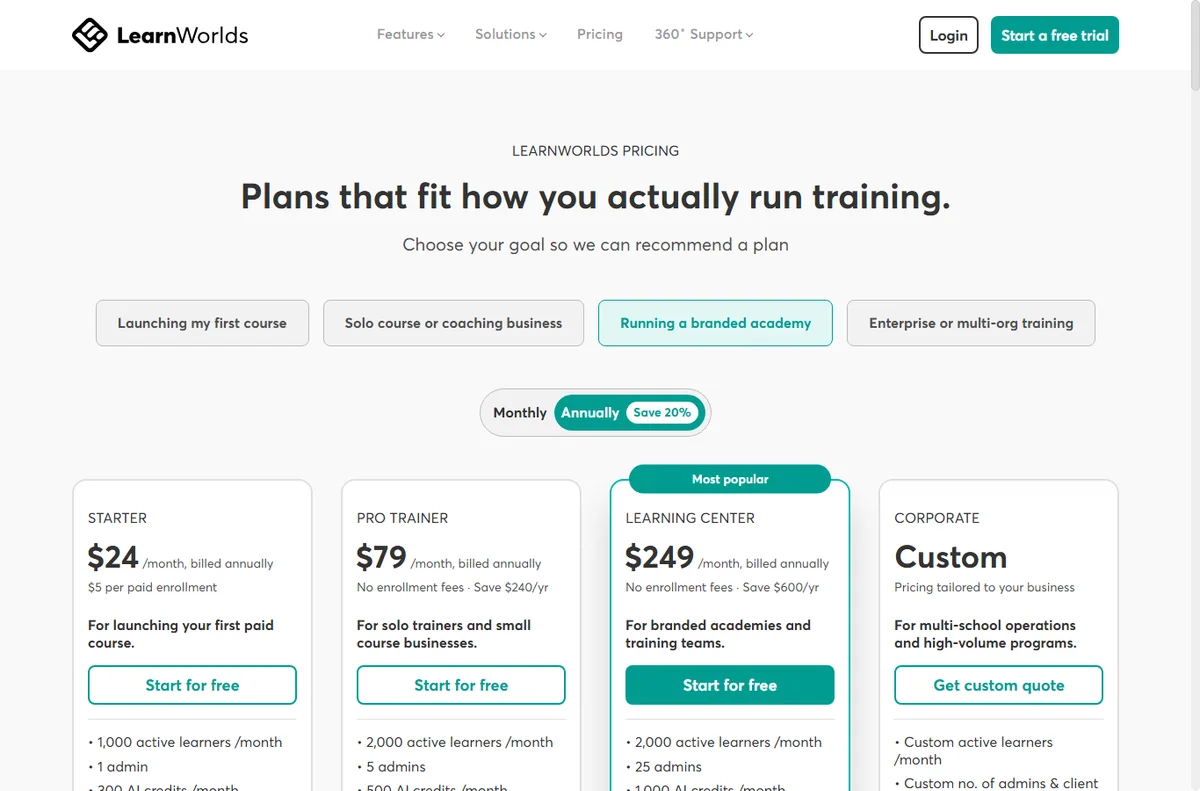
What is LearnWorlds?
LearnWorlds is an online course platform that lets you build, sell and run courses from a single account. This guide explains what it does, how its courses, site builder and memberships fit together, and what it is not.
Independent analysis. This page may contain affiliate links. If you sign up through a link on this page we may earn a reward at no extra cost to you, and it never changes what we recommend. We are an independent publisher and are not affiliated with, endorsed by, or an official partner of any tool mentioned. See our Affiliate Disclosure.
TL;DR
LearnWorlds is a hosted platform for creating and selling online courses.
It combines a course builder, a site builder and a checkout in one account.
You rent the platform rather than install software on your own server.
Plans and fees change, so check the current pricing before you commit.
It is not a general website builder, and not the cheapest option for a single small course.
LearnWorlds is a hosted platform, not a plugin. You sign up, build your school inside it, and it looks after the servers, the updates and the payment handling for you.
Its job is to take a course from an outline to something people can buy and work through. That means lesson pages, video hosting, quizzes and a checkout in one place.
Around the lessons it adds the parts a course business needs: a small website, student accounts, drip schedules and a way to take payment.
Because it is hosted, you trade some control for convenience. You do not manage hosting or updates, but you also work within the features the platform offers.
A useful way to think about it: it is the school, the shop and the classroom combined, rather than one piece you bolt onto another.
Learnworlds blog (image: learnworlds.com)
How LearnWorlds is organised
Everything sits inside one school. You organise content into courses, courses into lessons, and lessons into sections, with multimedia, quizzes and assignments inside each.
A built-in site builder puts pages around the courses, so a homepage, a sales page and a blog all live in the same account rather than on a separate site.
Memberships and access rules decide who sees what. You can drip lessons over time, bundle courses, or sell a subscription instead of a one-off purchase.
The checkout and payments are handled in the same place, which means student accounts, receipts and access follow the sale automatically.
Learnworlds features (image: learnworlds.com)
What LearnWorlds is good at
Taking a course from idea to sale without stitching tools together.
Hosting video and lessons without managing your own server.
Dripping content and bundling courses with simple rules.
Running a small website and a checkout in one account.
Handling student accounts and access automatically after purchase.
Learnworlds integrations (image: learnworlds.com)
What LearnWorlds is not
Not a general-purpose website builder for any kind of site.
Not a one-off purchase; it is a subscription, so check the current pricing.
Not the best fit if you need deep custom code control.
Not a marketplace that brings you an audience; students still have to find you.
Concept cheat sheet
Concept
Meaning
Why it matters
Course
A collection of lessons sold as one product
It is the unit you build and sell
Section
A group of lessons inside a course
It gives long courses some shape
Drip
Releasing lessons on a schedule
It paces students through the material
Membership
A rule for who can see what
It controls access without manual work
Checkout
Where payment is taken
It links a sale to an account automatically
The small vocabulary that makes a course platform make sense.
Learnworlds pricing (image: learnworlds.com)
Where this fits
LearnWorlds sits in the Course Platforms section, next to the roundups of the best course platforms and the best online learning platforms. The LearnWorlds review compares it with alternatives, the setup guide and day-to-day guide cover the practical side, and the pricing guide helps you charge for what you build.
Learnworlds x about (image: learnworlds.com)
Frequently asked
Do I need my own website?
No. The platform includes a small site builder, so your pages can live inside your account.
Can I sell bundles or subscriptions?
Yes. Memberships and bundles let you sell more than one course, or ongoing access.
Do I need to host video myself?
No. Video hosting is part of the platform, so you do not manage a separate media server.
Can I use my own domain?
Yes. You can connect a custom domain to your school.
Is it a one-off payment?
No. It is a subscription, and plans change, so check the current pricing.
Build your course with LearnWorlds
Set up your school, add your lessons and start selling without managing servers.
Some links on this page may be referral links — we may earn a reward if you sign up, at no extra cost to you. We are an independent publisher. See our Affiliate Disclosure.
Rank tracking tools mostly fail quietly, which makes the symptoms easy to misread. This guide covers the Wincher issues that come up most and what to check first.
Independent analysis. This page may contain affiliate links. If you sign up through a link on this page we may earn a reward at no extra cost to you, and it never changes what we recommend. We are an independent publisher and are not affiliated with, endorsed by, or an official partner of any tool mentioned. See our Affiliate Disclosure.
TL;DR
Rank tracking problems usually come from the wrong location, a changed URL or a limit on the plan.
A keyword that stops updating is often paused, over a limit or simply checked less often.
A sudden jump is often a search engine change, not a real move.
Check the setup before you assume the data is broken.
If the numbers look wrong, compare with a manual search first.
Rank trackers report slowly and quietly. Nothing crashes, but the numbers drift, stall or stop, and it is not always obvious why.
Most causes sit in the setup rather than the software: a keyword tied to the wrong country, a page whose URL changed, or a plan that limits how often checks run.
Working from the simplest explanation upward will solve most of these quickly.
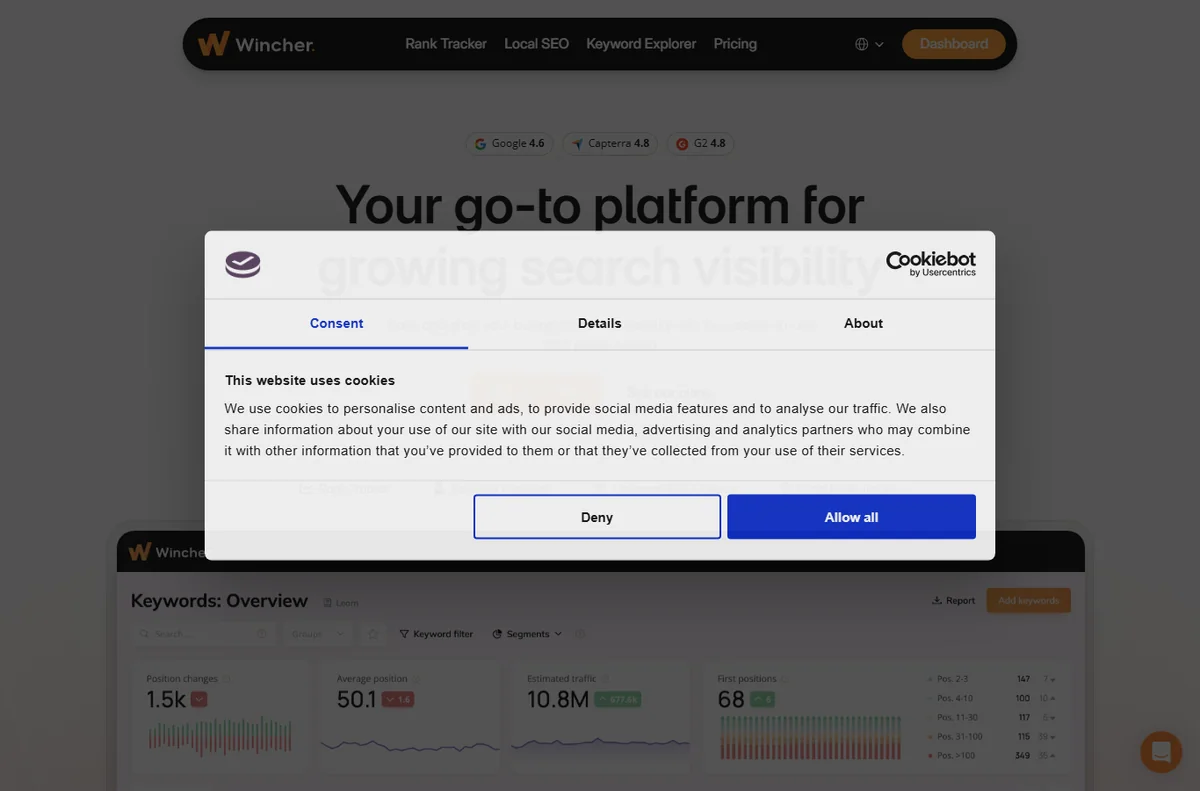
Wincher home (image: wincher.com)
Keywords stop updating
A keyword that shows the same position forever is usually paused or has hit a limit on how often it is checked.
Check whether the keyword is paused.
Confirm your plan still covers the number of keywords.
Re-add the keyword if it looks stuck.
Wincher blog (image: wincher.com)
Rankings look wrong
A result that does not match what you see in a browser often comes from location, device or personalisation differences.
Match the country and language settings.
Compare on a device with no personalisation.
Allow a day for a fresh check.
A big jump up or down
Large single-day moves are usually search engine updates or a page being re-indexed rather than a real ranking shift.
Wait a few days to confirm the trend.
Check whether the page changed or moved.
Look at competitors for the same keyword.
Wincher pricing (image: wincher.com)
URLs or pages changed
If a tracked page moved, the keyword can keep pointing at the old URL and show a false decline.
Update the tracked URL.
Add a redirect from the old page.
Re-check after the next run.
Wincher rank tracker (image: wincher.com)
Reports empty or slow
An empty report usually means there is not enough history yet, or the filters exclude every keyword.
Widen the date range.
Clear any filters.
Wait for the next scheduled check.
Symptom to fix
Symptom
Likely cause
Fix
Keyword never changes
Paused or over a limit
Resume it or upgrade the plan
Position looks wrong
Wrong location or device
Match country and language settings
Sudden big drop
Search engine update or re-index
Wait and confirm the trend
Old URL still tracked
Page moved
Update the URL and add a redirect
Report is blank
Too little history or heavy filters
Widen dates and clear filters
Slow updates
Plan check frequency
Check the current pricing for faster checks
What you see, what usually causes it, and the first thing to try.
Wincher y about (image: wincher.com)
Where this fits
These fixes sit alongside the other SEO Tools guides. Start with what Wincher is and the Wincher review if you are still choosing a tracker, then use the setup guide and the day-to-day guide to keep the data accurate.
Icode editorial illustration (image: icode.io.vn)
Frequently asked
Can I fix these myself?
Yes. Almost all of them are settings, URLs or timing, all of which you control from the dashboard.
Why does my rank differ from a manual search?
Location, device and personalisation all change results, so make sure you compare like for like.
Why did my ranking change overnight?
Search engines update their results constantly. A one-day move is often noise, so watch the trend instead.
Do I need to re-add keywords after a change?
Only if a tracked URL moved or the keyword was removed. Updating the URL is usually enough.
Keep your rankings accurate
Track the right keywords in the right location and trust the numbers you act on.
Some links on this page may be referral links — we may earn a reward if you sign up, at no extra cost to you. We are an independent publisher. See our Affiliate Disclosure.