ActiveCampaign vs MailerLite: which is better in 2026?
Choosing between ActiveCampaign and MailerLite? Here is a side-by-side look at pricing, strengths and fit, so you can pick the right one in a few minutes.
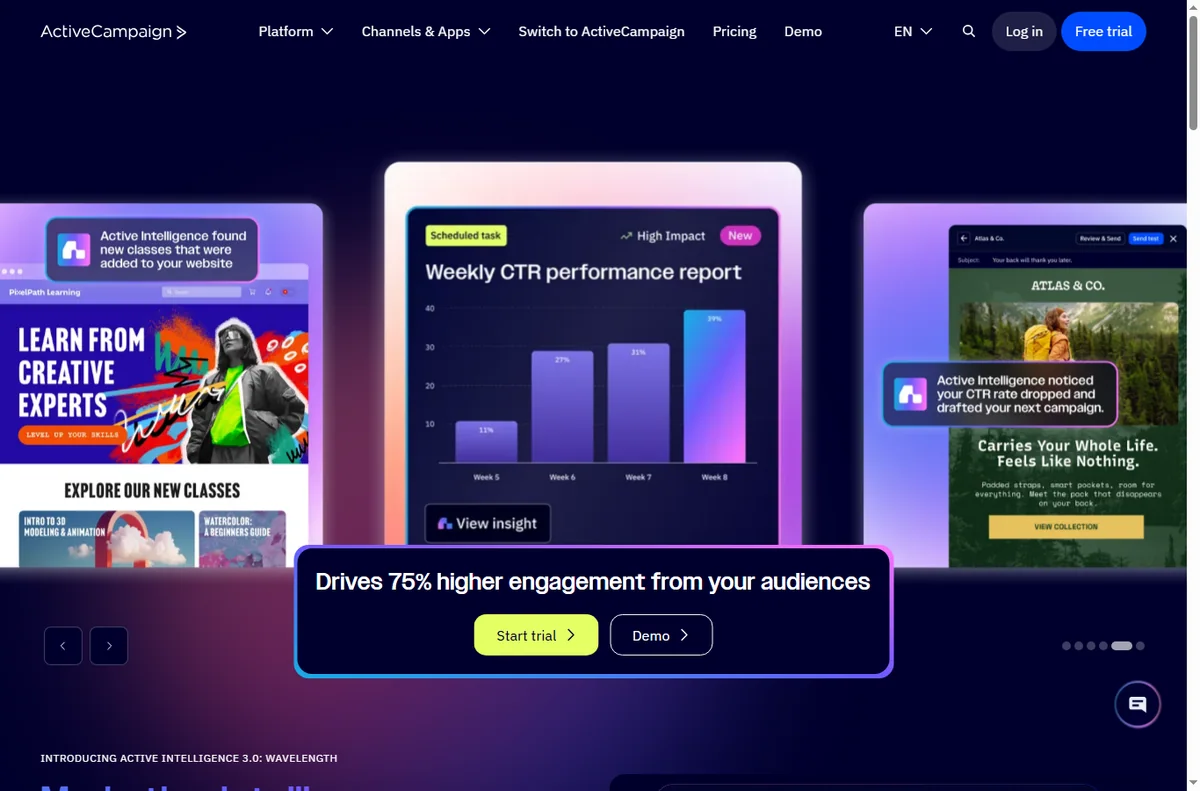
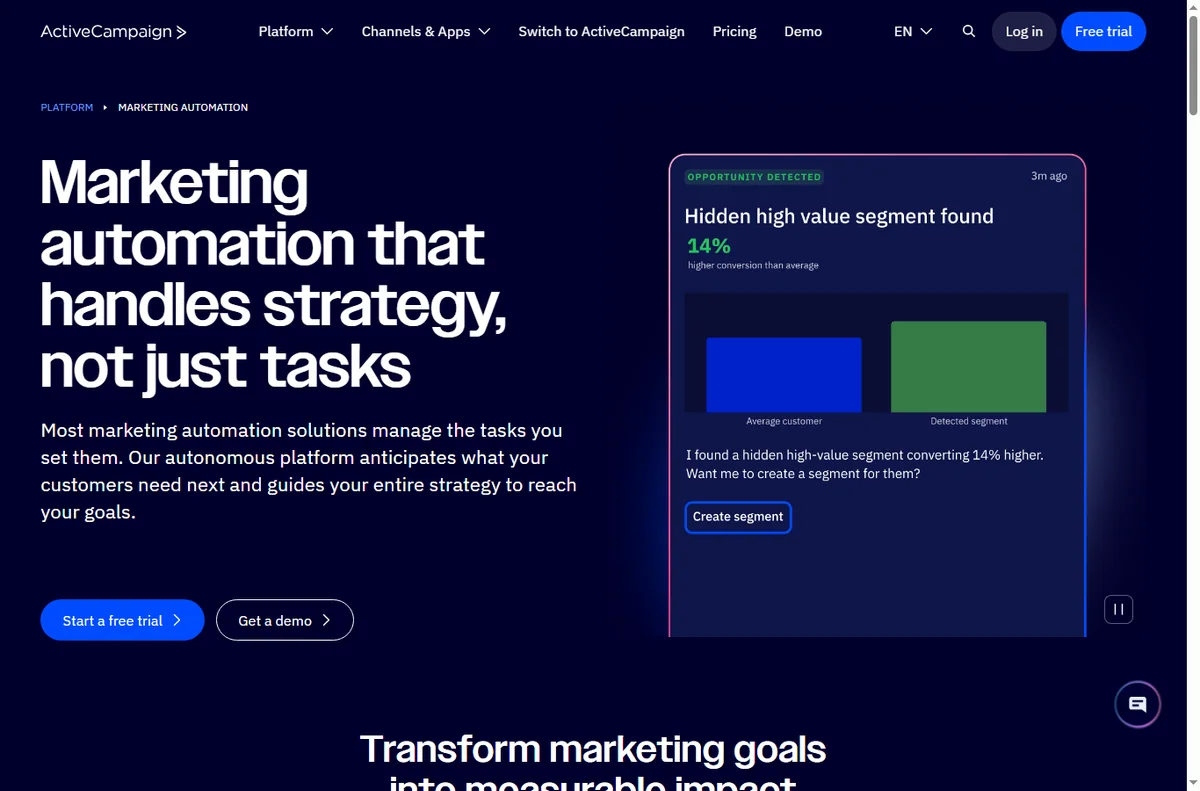
ActiveCampaign official site (image: activecampaign.com)
Independent analysis. This page may contain affiliate links. Some links here are referral links; if you sign up through one we may earn a reward at no extra cost to you, and it never changes what we recommend. See our Affiliate Disclosure.
TL;DR
ActiveCampaign is a better fit for businesses that need automation and a light CRM.
MailerLite is a better fit for beginners and small lists on a budget.
Pick ActiveCampaign when automation depth matters most to you.
Pick MailerLite when free-plan value matters most to you.
At a glance
Feature
ActiveCampaign
MailerLite
Starting price
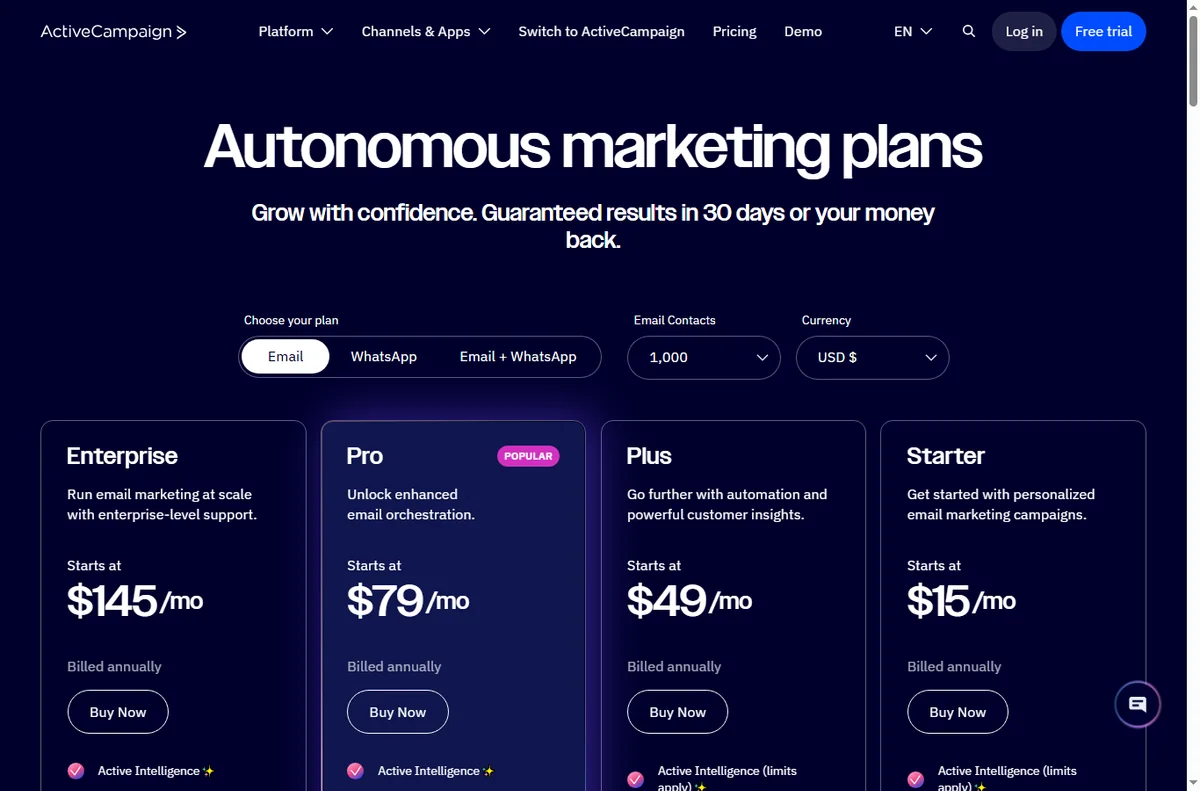
Paid plans from about $15/mo (trial only)
Free; paid plans from about $10/mo
Free plan
No
Yes
Best for
businesses that need automation and a light CRM
beginners and small lists on a budget
Standout strength
automation depth
free-plan value
Main trade-off
Pricier as contacts grow
Automation is less advanced than rivals
ActiveCampaign forms (image: activecampaign.com)
ActiveCampaign in brief
Email marketing plus marketing automation and a light CRM.
Pros: Deep automation and segmentation; Built-in CRM and lead scoring; Strong deliverability
Cons: Pricier as contacts grow; The CRM is basic next to dedicated tools; Can feel complex at first
Choose ActiveCampaign if you are businesses that need automation and a light CRM, or you value automation depth.
Choose MailerLite if you are beginners and small lists on a budget, or you value free-plan value.
You can also use both together: ActiveCampaign and MailerLite connect through native integrations, so many teams run one for automation depth and the other for free-plan value. Start with the one that matches your budget and workflow, and add the second when a clear gap appears.
There is no universal winner. ActiveCampaign leads on automation depth, while MailerLite leads on free-plan value. Match the tool to your budget and workflow.
Is MailerLite cheaper than ActiveCampaign?
On published pricing, ActiveCampaign starts at paid plans from about $15/mo (trial only) and MailerLite starts at free; paid plans from about $10/mo. Always check current pricing and renewal rates.
Can I use ActiveCampaign and MailerLite together?
Yes. Both offer integrations and APIs, so you can run them side by side and send data between them.
MailerLite vs GetResponse: which is better in 2026?
Choosing between MailerLite and GetResponse? Here is a side-by-side look at pricing, strengths and fit, so you can pick the right one in a few minutes.
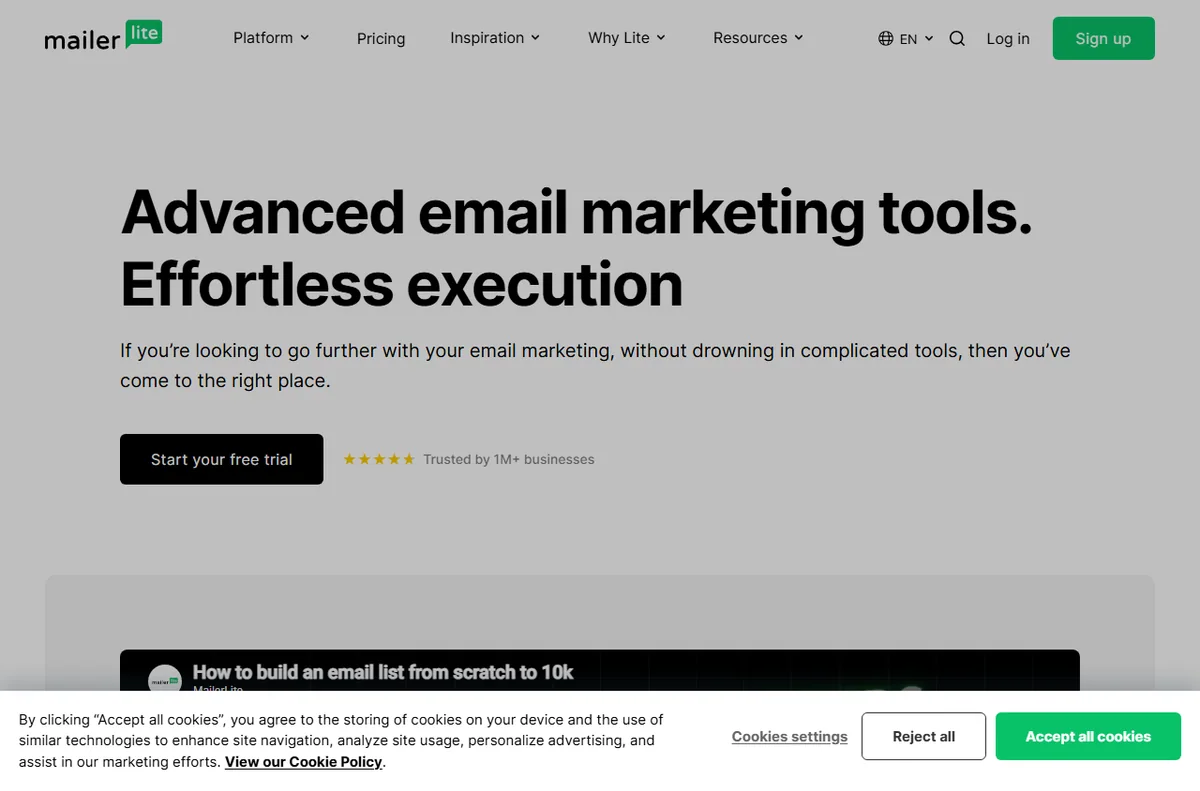
MailerLite official site (image: mailerlite.com)
Independent analysis. This page may contain affiliate links. Some links here are referral links; if you sign up through one we may earn a reward at no extra cost to you, and it never changes what we recommend. See our Affiliate Disclosure.
TL;DR
MailerLite is a better fit for beginners and small lists on a budget.
GetResponse is a better fit for marketers who want funnels and webinars in one tool.
Pick MailerLite when free-plan value matters most to you.
Pick GetResponse when all-in-one extras matters most to you.
At a glance
Feature
MailerLite
GetResponse
Starting price
Free; paid plans from about $10/mo
Free plan; paid plans from about $16/mo
Free plan
Yes
Yes
Best for
beginners and small lists on a budget
marketers who want funnels and webinars in one tool
Standout strength
free-plan value
all-in-one extras
Main trade-off
Automation is less advanced than rivals
The automation builder has limits
MailerLite features (image: mailerlite.com)
MailerLite in brief
Beginner-friendly email marketing with a generous free plan.
Pros: Free plan for up to 1,000 subscribers; Clean drag-and-drop builder; Easy automation builder
Cons: Automation is less advanced than rivals; Fewer integrations; Deliverability add-ons cost more
Choose MailerLite if you are beginners and small lists on a budget, or you value free-plan value.
Choose GetResponse if you are marketers who want funnels and webinars in one tool, or you value all-in-one extras.
You can also use both together: MailerLite and GetResponse connect through native integrations, so many teams run one for free-plan value and the other for all-in-one extras. Start with the one that matches your budget and workflow, and add the second when a clear gap appears.
There is no universal winner. MailerLite leads on free-plan value, while GetResponse leads on all-in-one extras. Match the tool to your budget and workflow.
Is GetResponse cheaper than MailerLite?
On published pricing, MailerLite starts at free; paid plans from about $10/mo and GetResponse starts at free plan; paid plans from about $16/mo. Always check current pricing and renewal rates.
Can I use MailerLite and GetResponse together?
Yes. Both offer integrations and APIs, so you can run them side by side and send data between them.
ActiveCampaign vs GetResponse: which is better in 2026?
Choosing between ActiveCampaign and GetResponse? Here is a side-by-side look at pricing, strengths and fit, so you can pick the right one in a few minutes.
ActiveCampaign official site (image: activecampaign.com)
Independent analysis. This page may contain affiliate links. Some links here are referral links; if you sign up through one we may earn a reward at no extra cost to you, and it never changes what we recommend. See our Affiliate Disclosure.
TL;DR
ActiveCampaign is a better fit for businesses that need automation and a light CRM.
GetResponse is a better fit for marketers who want funnels and webinars in one tool.
Pick ActiveCampaign when automation depth matters most to you.
Pick GetResponse when all-in-one extras matters most to you.
At a glance
Feature
ActiveCampaign
GetResponse
Starting price
Paid plans from about $15/mo (trial only)
Free plan; paid plans from about $16/mo
Free plan
No
Yes
Best for
businesses that need automation and a light CRM
marketers who want funnels and webinars in one tool
Choose ActiveCampaign if you are businesses that need automation and a light CRM, or you value automation depth.
Choose GetResponse if you are marketers who want funnels and webinars in one tool, or you value all-in-one extras.
You can also use both together: ActiveCampaign and GetResponse connect through native integrations, so many teams run one for automation depth and the other for all-in-one extras. Start with the one that matches your budget and workflow, and add the second when a clear gap appears.
There is no universal winner. ActiveCampaign leads on automation depth, while GetResponse leads on all-in-one extras. Match the tool to your budget and workflow.
Is GetResponse cheaper than ActiveCampaign?
On published pricing, ActiveCampaign starts at paid plans from about $15/mo (trial only) and GetResponse starts at free plan; paid plans from about $16/mo. Always check current pricing and renewal rates.
Can I use ActiveCampaign and GetResponse together?
Yes. Both offer integrations and APIs, so you can run them side by side and send data between them.
Choosing between n8n and Pabbly Connect? Here is a side-by-side look at pricing, strengths and fit, so you can pick the right one in a few minutes.
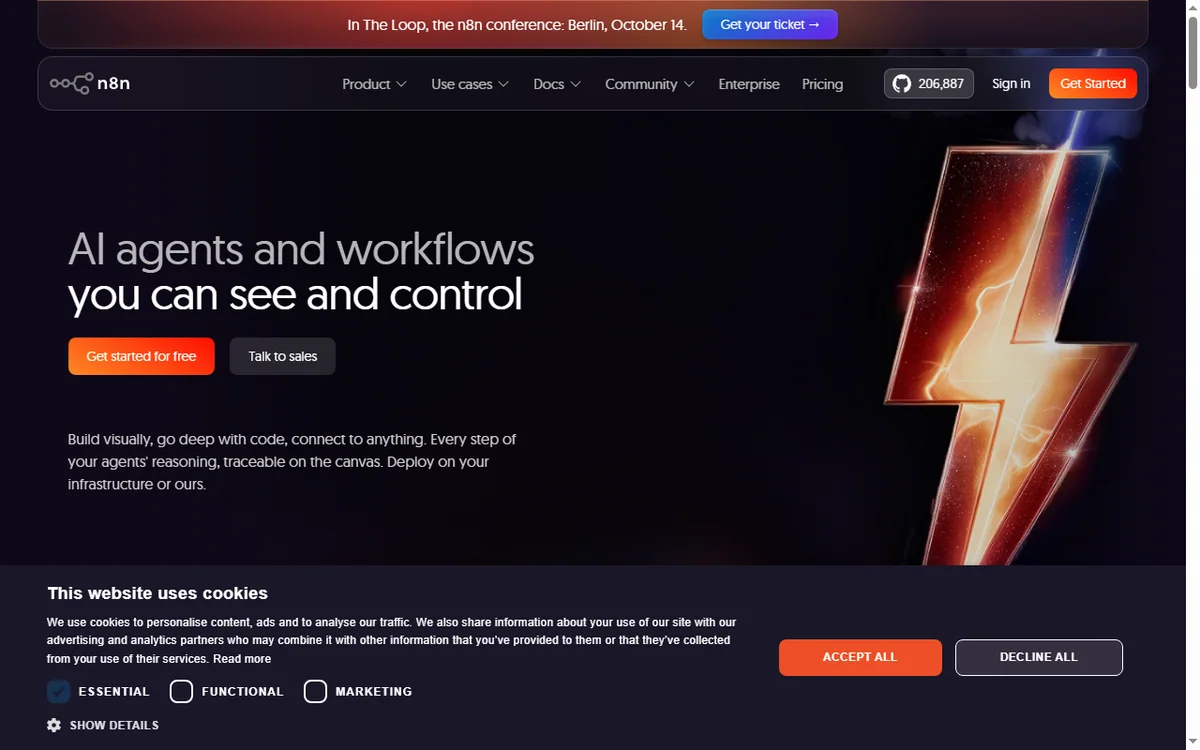
n8n official site (image: n8n.io)
Independent analysis. This page may contain affiliate links. Some links here are referral links; if you sign up through one we may earn a reward at no extra cost to you, and it never changes what we recommend. See our Affiliate Disclosure.
TL;DR
n8n is a better fit for technical teams that want control and privacy.
Pabbly Connect is a better fit for budget-conscious users with high task volume.
Pick n8n when self-hosting flexibility matters most to you.
Pick Pabbly Connect when flat-rate pricing matters most to you.
At a glance
Feature
n8n
Pabbly Connect
Starting price
Self-host free; cloud from about $24/mo
Free; paid plans from about $16/mo
Free plan
Yes
Yes
Best for
technical teams that want control and privacy
budget-conscious users with high task volume
Standout strength
self-hosting flexibility
flat-rate pricing
Main trade-off
Self-hosting needs technical skill
Smaller integration library
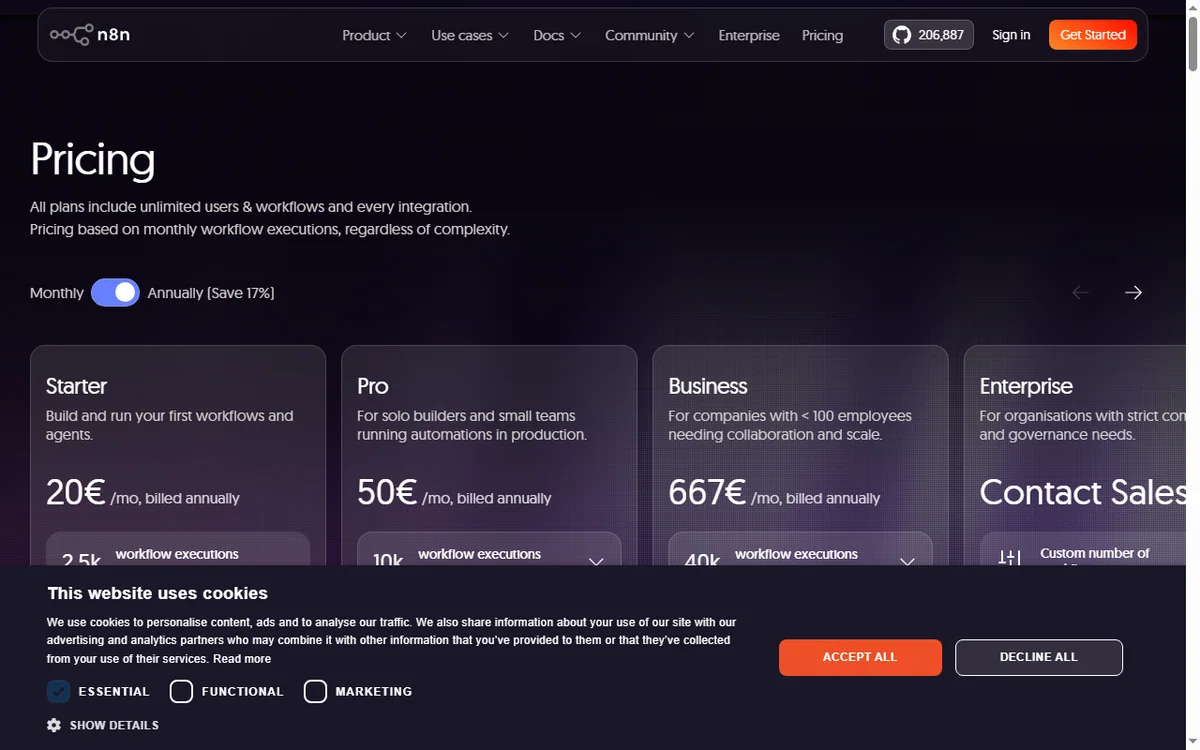
n8n workflows (image: n8n.io)
n8n in brief
Open-source, self-hostable automation with code when you need it.
Pros: Self-host to control costs and data; Code nodes for custom logic; Fair-code licence
Cons: Self-hosting needs technical skill; The cloud plan is newer; Docs assume some coding
Choose n8n if you are technical teams that want control and privacy, or you value self-hosting flexibility.
Choose Pabbly Connect if you are budget-conscious users with high task volume, or you value flat-rate pricing.
You can also use both together: n8n and Pabbly Connect connect through native integrations, so many teams run one for self-hosting flexibility and the other for flat-rate pricing. Start with the one that matches your budget and workflow, and add the second when a clear gap appears.
Compare on the official sites before you buy.n8n → | Pabbly Connect →(affiliate links)
Frequently asked questions
Is n8n better than Pabbly Connect?
There is no universal winner. n8n leads on self-hosting flexibility, while Pabbly Connect leads on flat-rate pricing. Match the tool to your budget and workflow.
Is Pabbly Connect cheaper than n8n?
On published pricing, n8n starts at self-host free; cloud from about $24/mo and Pabbly Connect starts at free; paid plans from about $16/mo. Always check current pricing and renewal rates.
Can I use n8n and Pabbly Connect together?
Yes. Both offer integrations and APIs, so you can run them side by side and send data between them.
Zapier vs Pabbly Connect: which is better in 2026?
Choosing between Zapier and Pabbly Connect? Here is a side-by-side look at pricing, strengths and fit, so you can pick the right one in a few minutes.
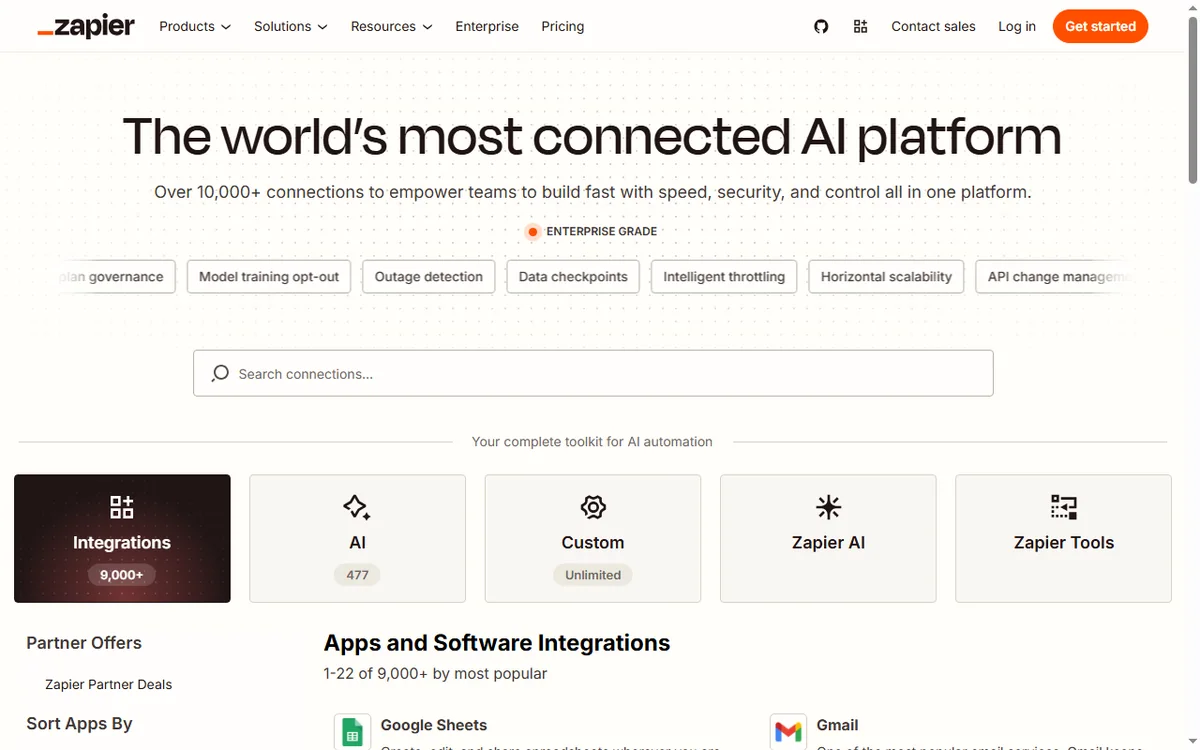
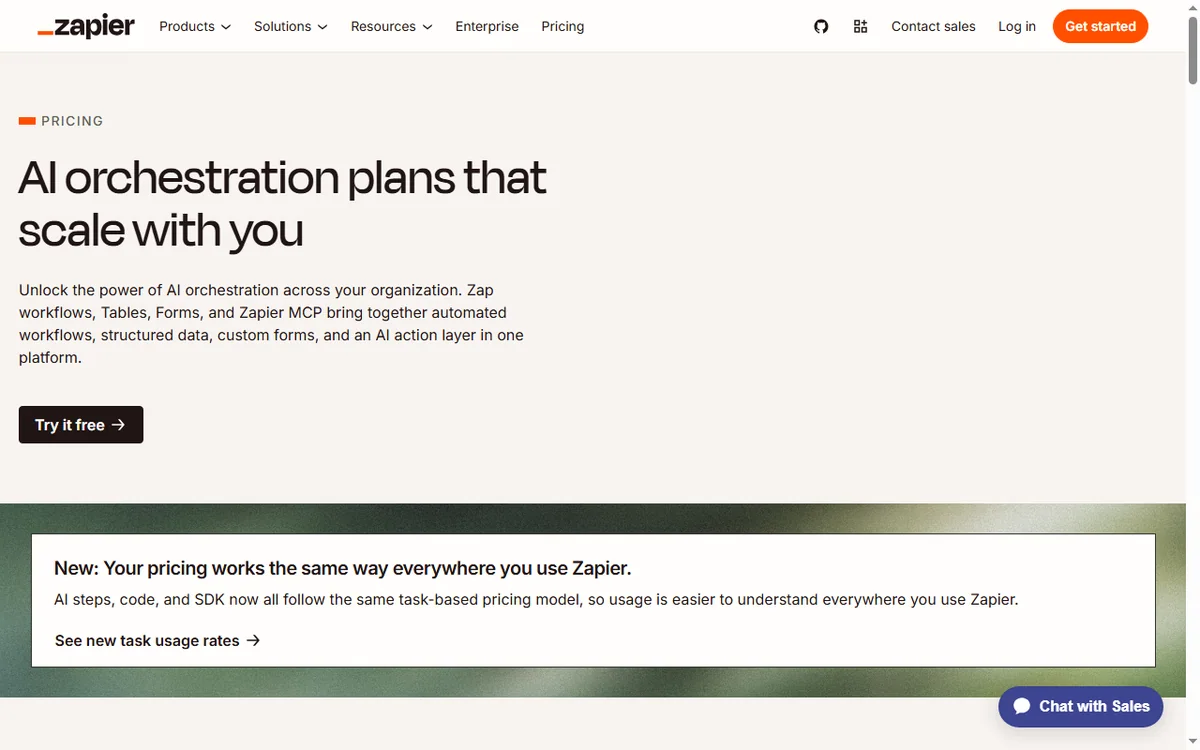
Zapier official site (image: zapier.com)
Independent analysis. This page may contain affiliate links. Some links here are referral links; if you sign up through one we may earn a reward at no extra cost to you, and it never changes what we recommend. See our Affiliate Disclosure.
TL;DR
Zapier is a better fit for beginners connecting two apps quickly.
Pabbly Connect is a better fit for budget-conscious users with high task volume.
Pick Zapier when breadth of integrations matters most to you.
Pick Pabbly Connect when flat-rate pricing matters most to you.
At a glance
Feature
Zapier
Pabbly Connect
Starting price
Free; paid plans from about $19.99/mo
Free; paid plans from about $16/mo
Free plan
Yes
Yes
Best for
beginners connecting two apps quickly
budget-conscious users with high task volume
Standout strength
breadth of integrations
flat-rate pricing
Main trade-off
Gets pricey as task volume grows
Smaller integration library
Zapier integrations (image: zapier.com)
Zapier in brief
The widest app-to-app integration library for simple automations.
Pros: Thousands of app integrations; Simple trigger-and-action setup; Reliable for linear tasks
Cons: Gets pricey as task volume grows; Multi-step logic is awkward; The free plan is very limited
Choose Zapier if you are beginners connecting two apps quickly, or you value breadth of integrations.
Choose Pabbly Connect if you are budget-conscious users with high task volume, or you value flat-rate pricing.
You can also use both together: Zapier and Pabbly Connect connect through native integrations, so many teams run one for breadth of integrations and the other for flat-rate pricing. Start with the one that matches your budget and workflow, and add the second when a clear gap appears.
There is no universal winner. Zapier leads on breadth of integrations, while Pabbly Connect leads on flat-rate pricing. Match the tool to your budget and workflow.
Is Pabbly Connect cheaper than Zapier?
On published pricing, Zapier starts at free; paid plans from about $19.99/mo and Pabbly Connect starts at free; paid plans from about $16/mo. Always check current pricing and renewal rates.
Can I use Zapier and Pabbly Connect together?
Yes. Both offer integrations and APIs, so you can run them side by side and send data between them.
Choosing between Zapier and n8n? Here is a side-by-side look at pricing, strengths and fit, so you can pick the right one in a few minutes.
Zapier official site (image: zapier.com)
Independent analysis. This page may contain affiliate links. Some links here are referral links; if you sign up through one we may earn a reward at no extra cost to you, and it never changes what we recommend. See our Affiliate Disclosure.
TL;DR
Zapier is a better fit for beginners connecting two apps quickly.
n8n is a better fit for technical teams that want control and privacy.
Pick Zapier when breadth of integrations matters most to you.
Pick n8n when self-hosting flexibility matters most to you.
At a glance
Feature
Zapier
n8n
Starting price
Free; paid plans from about $19.99/mo
Self-host free; cloud from about $24/mo
Free plan
Yes
Yes
Best for
beginners connecting two apps quickly
technical teams that want control and privacy
Standout strength
breadth of integrations
self-hosting flexibility
Main trade-off
Gets pricey as task volume grows
Self-hosting needs technical skill
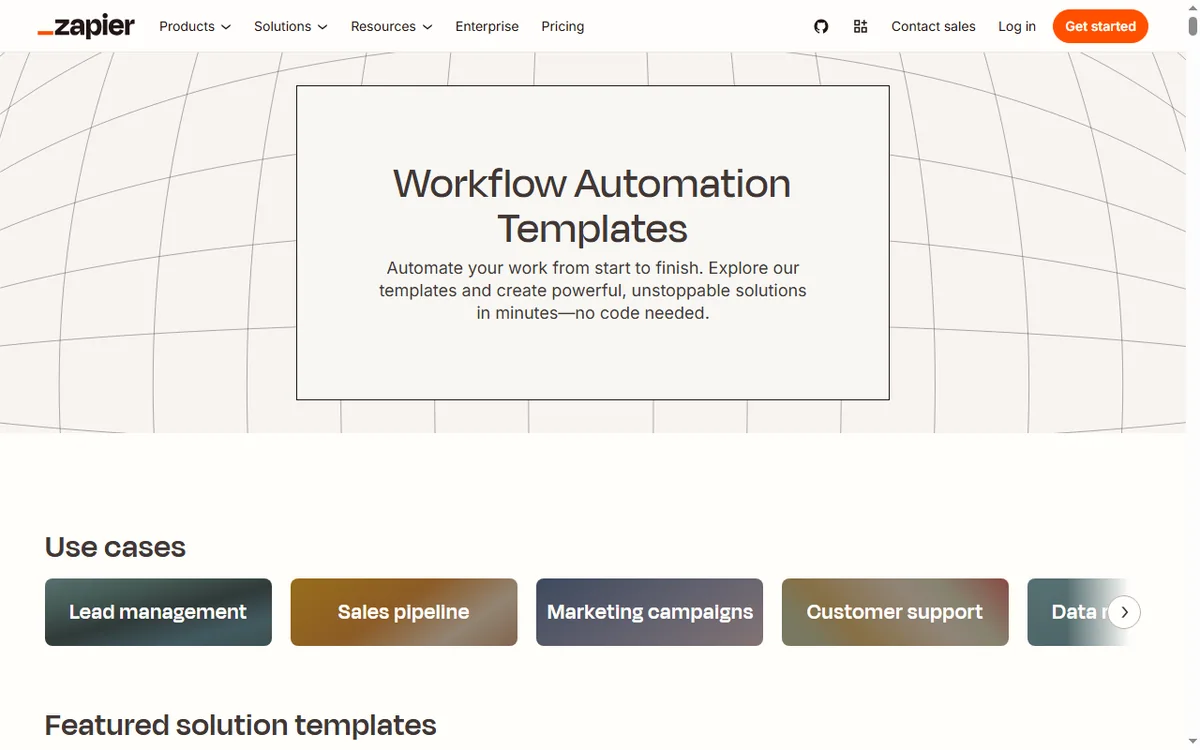
Zapier templates (image: zapier.com)
Zapier in brief
The widest app-to-app integration library for simple automations.
Pros: Thousands of app integrations; Simple trigger-and-action setup; Reliable for linear tasks
Cons: Gets pricey as task volume grows; Multi-step logic is awkward; The free plan is very limited
Choose Zapier if you are beginners connecting two apps quickly, or you value breadth of integrations.
Choose n8n if you are technical teams that want control and privacy, or you value self-hosting flexibility.
You can also use both together: Zapier and n8n connect through native integrations, so many teams run one for breadth of integrations and the other for self-hosting flexibility. Start with the one that matches your budget and workflow, and add the second when a clear gap appears.
Compare on the official sites before you buy.Zapier → | n8n →(affiliate links)
Frequently asked questions
Is Zapier better than n8n?
There is no universal winner. Zapier leads on breadth of integrations, while n8n leads on self-hosting flexibility. Match the tool to your budget and workflow.
Is n8n cheaper than Zapier?
On published pricing, Zapier starts at free; paid plans from about $19.99/mo and n8n starts at self-host free; cloud from about $24/mo. Always check current pricing and renewal rates.
Can I use Zapier and n8n together?
Yes. Both offer integrations and APIs, so you can run them side by side and send data between them.
Choosing between Make and Pabbly Connect? Here is a side-by-side look at pricing, strengths and fit, so you can pick the right one in a few minutes.
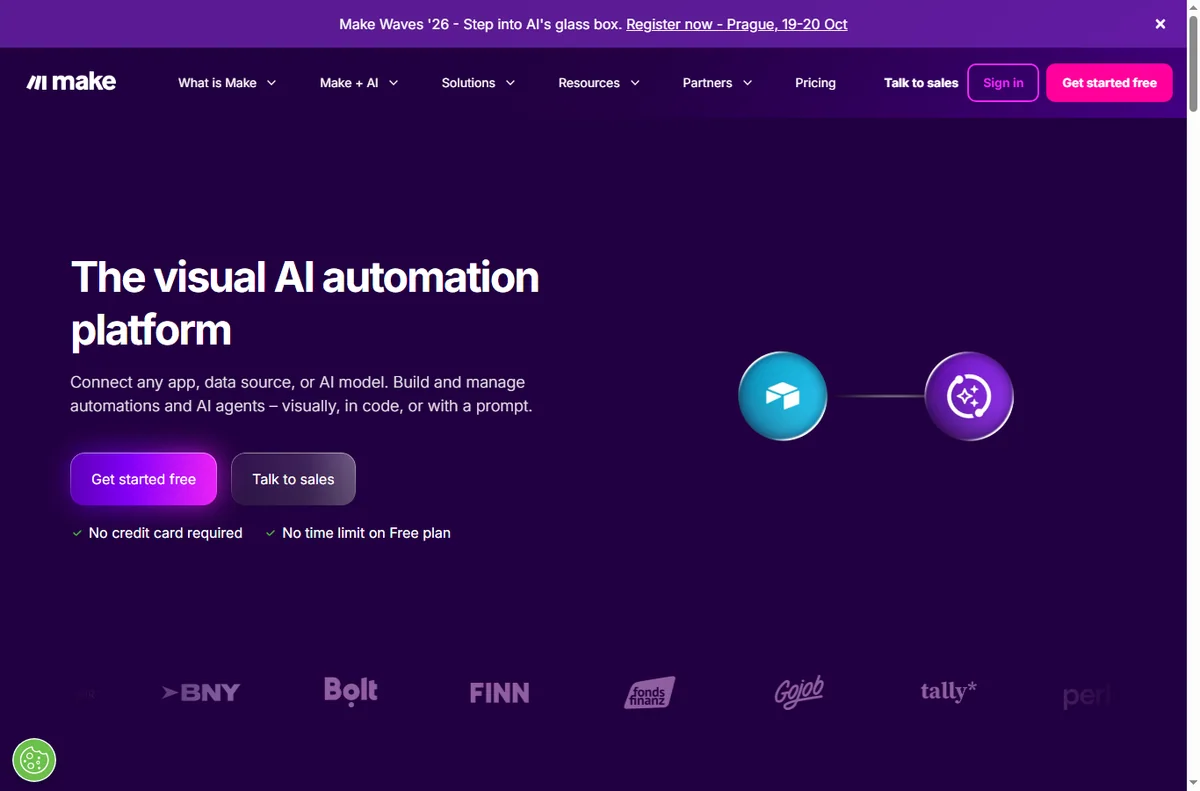
Make official site (image: make.com)
Independent analysis. This page may contain affiliate links. Some links here are referral links; if you sign up through one we may earn a reward at no extra cost to you, and it never changes what we recommend. See our Affiliate Disclosure.
TL;DR
Make is a better fit for teams that want visual control over complex workflows.
Pabbly Connect is a better fit for budget-conscious users with high task volume.
Pick Make when visual power at volume matters most to you.
Pick Pabbly Connect when flat-rate pricing matters most to you.
At a glance
Feature
Make
Pabbly Connect
Starting price
Free; paid plans from about $9/mo
Free; paid plans from about $16/mo
Free plan
Yes
Yes
Best for
teams that want visual control over complex workflows
budget-conscious users with high task volume
Standout strength
visual power at volume
flat-rate pricing
Main trade-off
Steeper learning curve than simpler tools
Smaller integration library
Make templates (image: make.com)
Make in brief
Visual, no-code automation for multi-step workflows.
Pros: Drag-and-drop scenario builder; Large app library plus HTTP and webhook modules; Cheaper than rivals at high operation counts
Cons: Steeper learning curve than simpler tools; Operations-based pricing can surprise you; Errors often need manual debugging
Choose Make if you are teams that want visual control over complex workflows, or you value visual power at volume.
Choose Pabbly Connect if you are budget-conscious users with high task volume, or you value flat-rate pricing.
You can also use both together: Make and Pabbly Connect connect through native integrations, so many teams run one for visual power at volume and the other for flat-rate pricing. Start with the one that matches your budget and workflow, and add the second when a clear gap appears.
There is no universal winner. Make leads on visual power at volume, while Pabbly Connect leads on flat-rate pricing. Match the tool to your budget and workflow.
Is Pabbly Connect cheaper than Make?
On published pricing, Make starts at free; paid plans from about $9/mo and Pabbly Connect starts at free; paid plans from about $16/mo. Always check current pricing and renewal rates.
Can I use Make and Pabbly Connect together?
Yes. Both offer integrations and APIs, so you can run them side by side and send data between them.
Knowledge · funnel builders · updated October 9, 2026
Systeme.io free plan explained: what you get and the limits
Systeme.io is unusual in offering a genuinely usable free plan. Here is what a free account lets you do, where the limits bite, and when it is worth upgrading.
Independent analysis. This page may contain affiliate links. If you sign up through a link on this page we may earn a reward at no extra cost to you, and it never changes what we recommend. We are an independent publisher and are not affiliated with, endorsed by, or an official partner of any tool mentioned. See our Affiliate Disclosure.
TL;DR
The free plan lets you build funnels, collect leads and sell, without a credit card.
The main limits are on contacts, emails and premium features rather than on whether you can launch.
It is enough to validate an offer and learn the platform before you pay.
Upgrade when your list or your traffic outgrows the ceilings, not before.
Confirm the current limits and pricing on the official site — they change.
Most funnel builders ask for a card before you can build anything. Systeme.io takes the opposite approach: its free plan lets you create funnels, capture leads and run a basic business without paying up front.
That makes it a useful way to learn the workflow and test an idea before you commit. The free plan is real, but it is a starting tier, not a finished business — the limits are deliberate and worth understanding. The plan is a genuine starting tier, not a disguised trial, so it is worth knowing exactly where the ceiling sits before you build.
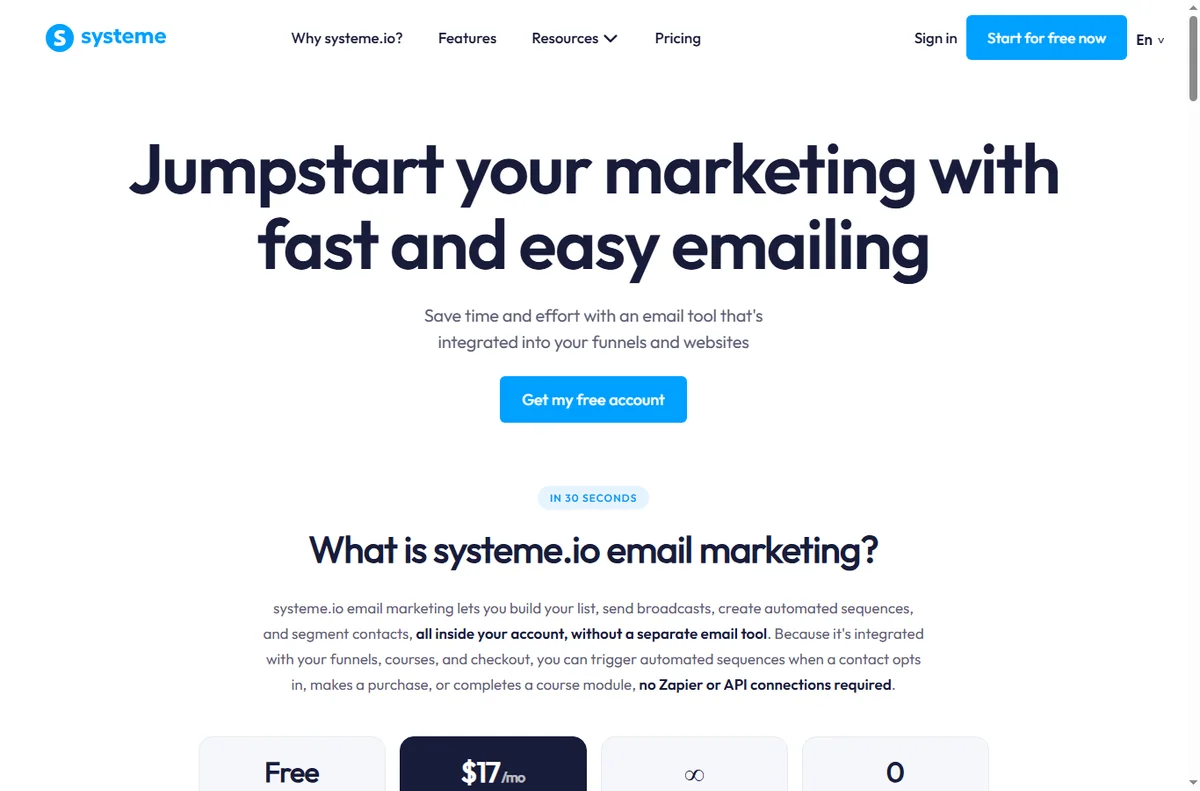
Systeme email marketing (image: systeme.io)
How the free plan works
You sign up, pick a funnel template and publish. The builder gives you landing pages, opt-in forms, an email list and basic automation in the same account as your course content.
Because everything lives in one place, there is no integration tax: no connectors to buy, no passwords to juggle. The catch is that the free tier caps how much you can send and how many contacts you can hold. In practice that means a beginner can run a real, if small, funnel and email campaign without a card on file.
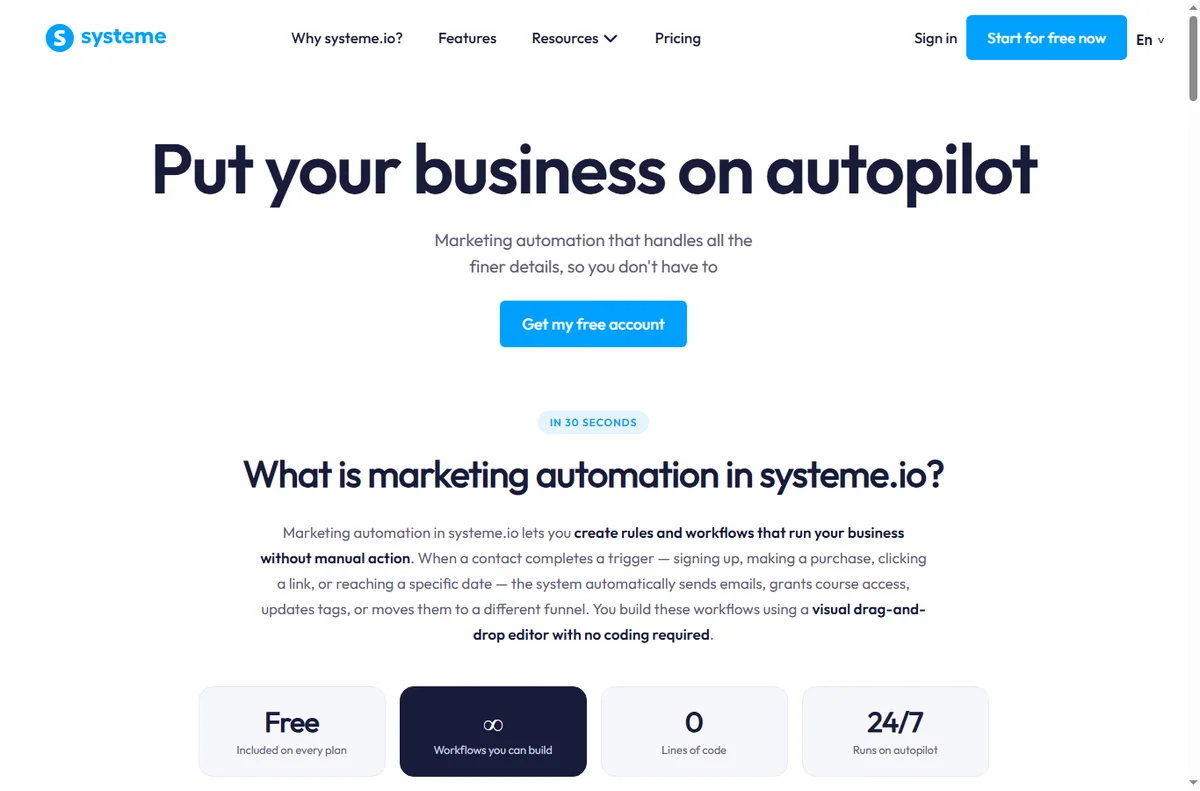
Systeme marketing automation (image: systeme.io)
What you get for free
Build and publish funnels and landing pages.
Collect leads and hold them in a built-in contact list.
Send emails to your list up to the plan limits.
Sell a product or course without a separate storefront.
Learn the whole platform before paying anything.
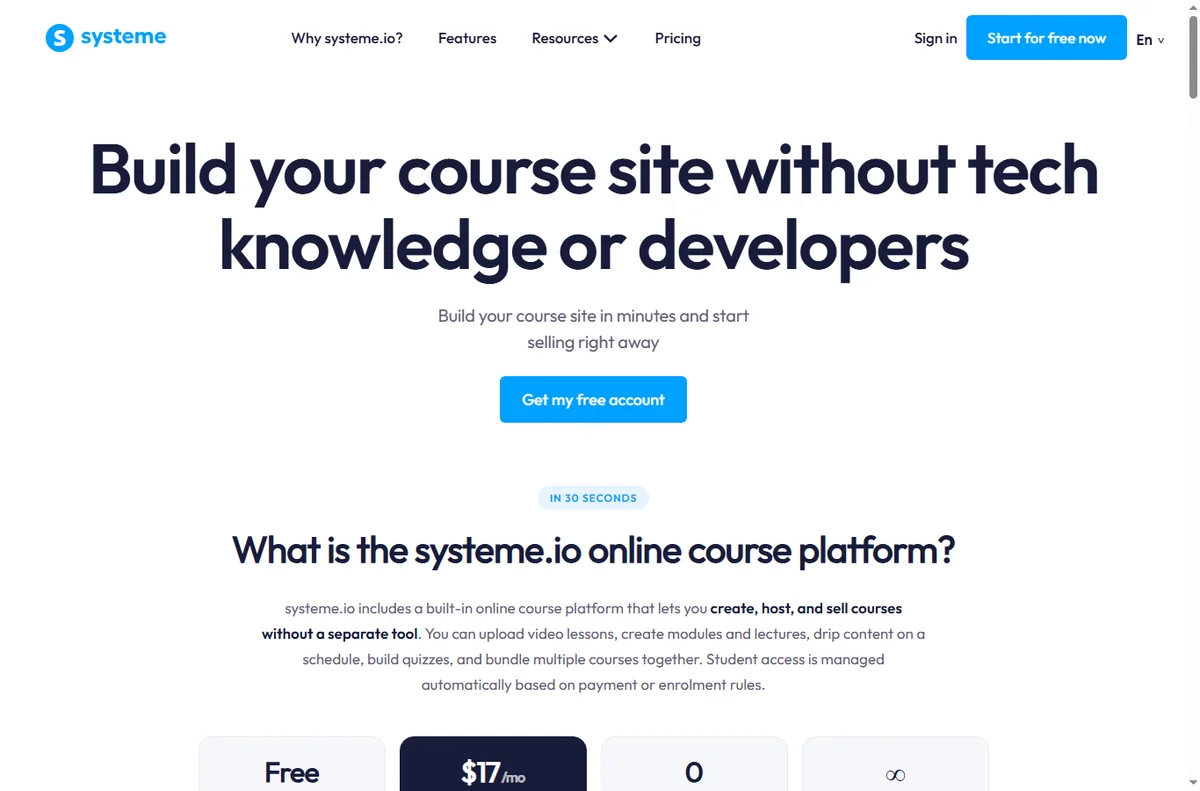
Systeme online courses (image: systeme.io)
Where the free plan stops
Contact and email limits that a growing list will hit.
Some premium features and higher capacity are paid-only.
Advanced automation and scale features sit on higher tiers.
Support and branding expectations differ from paid plans.
You will outgrow it once you market seriously — that is by design.
Key terms, plainly
Concept
Meaning
Why it matters
Free plan
A no-card starting tier with core funnel, email and course features.
Lets you validate an offer before you pay.
Contact limit
The number of leads your list can hold on the free tier.
The first ceiling a growing business hits.
Email limit
How many emails you can send within the plan.
Decides whether you can run real campaigns.
Upsell
Selling on the thank-you or checkout step.
Where growth-minded sellers earn more per lead.
Upgrade trigger
The moment the free limits slow you down.
Tells you when paying is genuinely worth it.
Plain-language terms only. Confirm exact limits on the official pricing page.
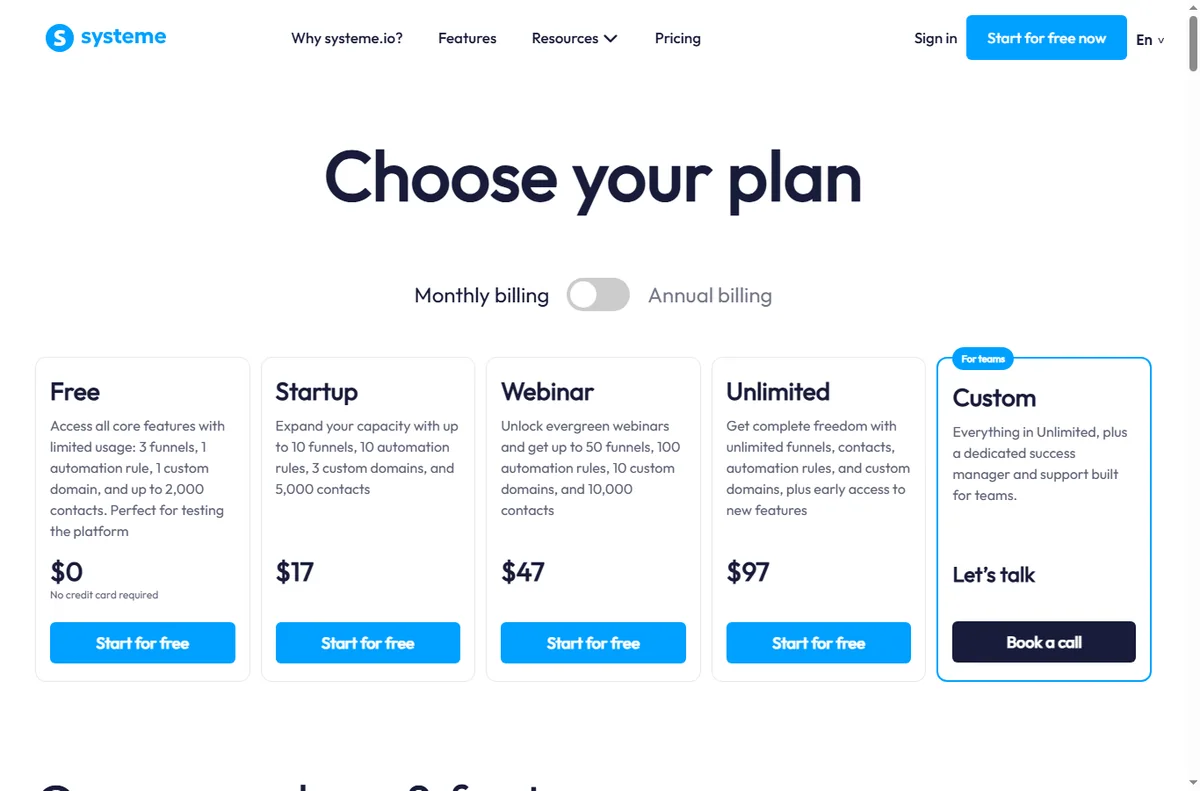
Systeme pricing (image: systeme.io)
Where this fits
The free plan fits anyone testing whether funnels and email marketing work for them, and anyone who wants to learn the platform without risk. If you are validating a course, a lead magnet or a first offer, it is enough to get real feedback. Once leads convert consistently and the limits start to slow you down, that is your signal to upgrade rather than a sign something is wrong. For the paid tiers and what they add, see the Systeme.io pricing guide, and for the bigger picture read our Systeme.io review.
Systeme register (image: systeme.io)
Frequently asked
Is the Systeme.io free plan really free?
Yes — you can build and launch without paying, and no card is required to start. The trade-off is limits on contacts, emails and premium features. Check the current limits on the official site.
What are the main limits?
The free plan caps your contacts and email sending, and reserves some advanced features for paid tiers. For most beginners those limits are generous enough to validate an offer.
When should I upgrade?
Upgrade when the limits actually slow you down — when your list outgrows the contact cap or you need premium automation. Upgrading before then just spends money you do not need to spend yet.
Can I sell courses on the free plan?
You can start selling with the free account, within its limits. Heavy course or membership businesses will want a paid tier for capacity and features.
Start free, upgrade only when you grow
No card needed to build your first funnel. Check the current limits on the official site.
Some links on this page may be referral links — we may earn a reward if you sign up, at no extra cost to you. We are an independent publisher. See our Affiliate Disclosure.
Comparison · funnel builders · updated October 9, 2026
Systeme.io vs Kartra: pricing, features and who should pick each
Systeme.io and Kartra are both all-in-one marketing platforms, so the comparison is closer than it looks. Here is how they differ on features, commitment and the type of creator each one suits.
Independent analysis. This page may contain affiliate links. If you sign up through a link on this page we may earn a reward at no extra cost to you, and it never changes what we recommend. We are an independent publisher and are not affiliated with, endorsed by, or an official partner of any tool mentioned. See our Affiliate Disclosure.
TL;DR
Both bundle funnels, email and courses — so the choice is about depth, commitment and fit.
Systeme.io is the simpler, lower-entry all-in-one; Kartra leans into memberships and campaign depth.
If memberships and video are central, look closely at Kartra.
If you want the easiest all-in-one starting point, Systeme.io is usually the lighter lift.
Check the current pricing on both sites — plans are revised regularly.
Because both platforms are all-in-one, we compared them on the features that separate a hobby project from a business: membership and video support, campaign automation, course delivery, and how quickly a beginner can launch.
We do not quote specific prices here. Both vendors restructure tiers regularly, so the honest answer is to check the current pricing and match a tier to your usage. The goal is to pick the platform you will still be happy with at your next growth stage, not the one with the longest checklist.
Systeme email marketing (image: systeme.io)
At a glance
Aspect
Systeme.io
Kartra
Positioning
Simple all-in-one
Premium all-in-one
Funnels
Yes
Yes
Email + automation
Yes
Yes, advanced campaigns
Memberships / video
Courses, lighter video
Strong memberships and video
Learning curve
Gentle
Moderate
Pricing
Check the current pricing
Check the current pricing
Emphasis comparison. Verify current features and plans with each vendor.
Systeme marketing automation (image: systeme.io)
Where Systeme.io fits
Systeme.io aims to give you the whole toolkit without a steep bill or a steep learning curve. Funnels, email, automation and courses live in one account, which makes it a natural first platform for a solo marketer or small team.
It is the friendlier starting point if you are still proving the offer. Our Systeme.io review and pricing guide cover the specifics.
Where Kartra fits
Kartra targets creators who want a premium, everything-under-one-roof platform with strong membership sites, video hosting and detailed campaign logic. If your business is built around a paid membership or a media library, that depth is valuable.
It usually asks for more commitment — in budget and in learning time — so it rewards creators who will genuinely use the membership and automation depth. See our Kartra overview.
Systeme online courses (image: systeme.io)
Features that decide it
Strip away the marketing and a few features usually decide the choice: how central memberships and video are, how much automation you actually build, and whether you need a big template library.
If you mainly need a funnel plus email plus a simple course, Systeme.io covers it. If you run a membership business with video at its core, Kartra is built for that pattern.
Cost and commitment
Treat the decision as a commitment question rather than a sticker-price question. An all-in-one only pays off if you use most of the stack; otherwise you are paying for features you ignore.
Match each tier to the modules you will use this quarter, then re-check the current pricing before you buy.
Systeme pricing (image: systeme.io)
Who should pick each?
Pick Systeme.io if you want the simplest, lowest-commitment route to an all-in-one stack — funnels, email and courses in one place — and you would rather start light and grow. Pick Kartra if memberships, video and advanced campaigns are central to your business and you are ready for a heavier platform.
Both are capable; the deciding factor is usually the kind of business you run, not a single feature.
A useful rule: if you cannot name three features on the higher tier that you will use every week, you are buying capability rather than results. Start where you will actually work, and revisit the choice after a quarter of real use.
Solo founder or small team starting out: Systeme.io.
Membership or video-led business: Kartra.
Unsure? Start on the lighter platform and migrate when memberships become central.
Systeme register (image: systeme.io)
Frequently asked
Is Kartra better than Systeme.io?
Neither is better outright. Kartra goes deeper on memberships and campaigns; Systeme.io is simpler and lighter to start. Compare the current plans against your workflow.
Do both include email marketing?
Yes, both include email marketing. Kartra emphasises advanced campaign automation, while Systeme.io keeps email, funnels and courses in one straightforward account.
Which is easier for beginners?
Systeme.io generally has the gentler learning curve, partly because it keeps the interface and the stack simpler. Kartra rewards users who take time to learn its depth.
Do either offer a free plan?
Systeme.io has a free plan with limits; Kartra does not. Always check the current pricing and limits before deciding.
Compare both before you commit
Start on the free option and upgrade only when you outgrow it.
Some links on this page may be referral links — we may earn a reward if you sign up, at no extra cost to you. We are an independent publisher. See our Affiliate Disclosure.
Comparison · funnel builders · updated October 9, 2026
Systeme.io vs ClickFunnels: which funnel builder fits you?
Quick answer. In short: choose Systeme.io for value and a free tier, and ClickFunnels for polish and advanced funnels. For most small teams Systeme.io is the quicker start, while ClickFunnels rewards heavier workflows. Both are capable tools; the right answer depends on your budget and how much setup you can tolerate.
Both tools build sales funnels, but they aim at different budgets and skill levels. Here is a straight comparison of features, ease of use and who each one actually suits.
Independent analysis. This page may contain affiliate links. If you sign up through a link on this page we may earn a reward at no extra cost to you, and it never changes what we recommend. We are an independent publisher and are not affiliated with, endorsed by, or an official partner of any tool mentioned. See our Affiliate Disclosure.
TL;DR
Systeme.io is an all-in-one stack: funnels, email and courses in one account, easy to start.
ClickFunnels is a dedicated funnel builder with deeper control and a bigger template library.
If you want one account and a low entry point, Systeme.io is simpler.
If you run complex, high-traffic funnels and want fine control, ClickFunnels goes deeper.
Both revise pricing regularly — confirm the current plans on each site.
We judged both tools on the same four questions: how quickly you can launch a first funnel, how much is included versus added on, how steep the learning curve is, and how easy it is to keep costs predictable as you grow.
We deliberately do not quote price figures, because both vendors change plans often. Use the links to check the current pricing instead of relying on outdated numbers.
Systeme email marketing (image: systeme.io)
At a glance
Aspect
Systeme.io
ClickFunnels
Core focus
All-in-one funnels, email and courses
Advanced funnel building
Learning curve
Gentle
Moderate to steep
Email marketing
Built in
Limited / separate tool
Online courses
Built in
Add-on or separate
Free option
Free plan available
No free plan
Pricing
Check the current pricing
Check the current pricing
Summary of emphasis only. Features and plans change — verify with each vendor.
Systeme marketing automation (image: systeme.io)
Where Systeme.io fits
Systeme.io is built to remove tool sprawl. You can build the funnel, send the emails that follow up, and host a course, all inside one account with one login and one bill. For a first funnel or a side business, that reduces both cost and confusion.
The free plan lets you learn the workflow before paying anything, and the paid tiers scale as your list grows. See the Systeme.io review and pricing guide for details.
Where ClickFunnels fits
ClickFunnels is for people who treat funnels as the product. It offers deep control over each step, a large library of proven templates and the flexibility to build complicated offer sequences. Teams spending real money on traffic often value that control.
The cost of that depth is complexity and a separate email or course stack. If you are early, that overhead can slow you down before you have traffic to optimise.
Systeme online courses (image: systeme.io)
Cost and scaling
The simplest way to decide is to plan for growth. If you expect to grow your list, launch courses and run several funnels, an all-in-one like Systeme.io keeps the stack and the bill simple. If your revenue depends on squeezing more from high-traffic funnels, ClickFunnels is designed for that scale.
Never compare from memory: open both pricing pages side by side and match each tier to what you will actually use.
Support, templates and community
ClickFunnels has a large, established community and a deep template catalogue. Systeme.io leans on an in-house education and template library that is well suited to beginners.
If you learn best from a big community, ClickFunnels has more of it. If you want guided, simpler onboarding, Systeme.io usually gets there faster.
Systeme pricing (image: systeme.io)
Which should you choose?
Pick Systeme.io if you want the fastest, cheapest route to a complete funnel with email and courses included, and you value simplicity over maximum control. Pick ClickFunnels if you are already running funnels at volume and need the deepest possible control over each step.
There is no wrong answer for the right stage: the mistake is buying depth you will not use, or hitting a ceiling you did not plan for.
First funnel, tight budget, want email and courses included: Systeme.io.
Established traffic, complex offer sequences, want fine control: ClickFunnels.
Unsure? Start on the free or lowest tier and upgrade when you outgrow it.
Systeme register (image: systeme.io)
Frequently asked
Is Systeme.io better than ClickFunnels?
Not universally. Systeme.io is a simpler all-in-one that suits most small businesses; ClickFunnels is deeper for high-volume funnel teams. Compare the current plans and your own workflow.
Does ClickFunnels include email marketing?
ClickFunnels is primarily a funnel builder, so email is limited or handled by a separate tool. Systeme.io includes email in the same account.
Can I switch later?
Yes. Both let you export your list, and funnels can be rebuilt. Start on the tool that matches your stage and migrate when it no longer fits.
Does Systeme.io have a free plan?
Yes, there is a free plan with limits. Check the current pricing and limits on the official site before you commit.
Some links on this page may be referral links — we may earn a reward if you sign up, at no extra cost to you. We are an independent publisher. See our Affiliate Disclosure.
In short: choose Systeme.io for value and a free tier, and ClickFunnels for polish and advanced funnels. For most small teams Systeme.io is the quicker start, while ClickFunnels rewards heavier workflows. Both are capable tools; the right answer depends on your budget and how much setup you can tolerate.
Systeme.io vs ClickFunnels: which is better?
Systeme.io is better for value and a free tier; ClickFunnels is better for polish and advanced funnels. Most small teams should pick based on which of those two matches their workflow, then check current pricing.
Can I switch later?
Yes. Both Systeme.io and ClickFunnels let you export and re-import data, though migration always takes some effort. Starting on the cheaper plan and moving when you outgrow it is a common, low-risk path.
Which is cheaper?
Pricing changes often, so check each provider directly. In general the two are close at entry level; costs diverge once you add seats, contacts or higher usage tiers.