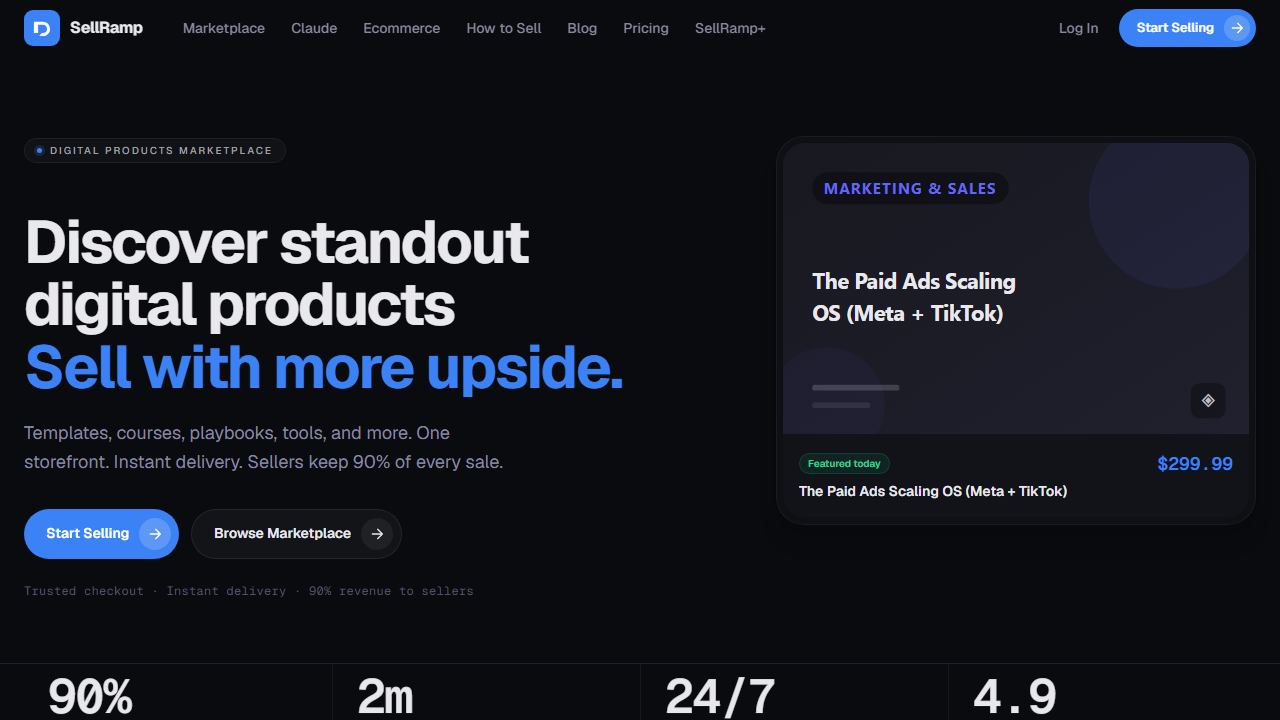
Short answer: freelancers buy tools to raise throughput without lowering the rate. SellRamp is a checkout and delivery layer for digital products that charges per sale instead of a monthly fee. It belongs in your stack only if it shortens taking payment and delivering a file the moment someone buys enough that you can either take another client or stop working evenings.
Independent analysis. This page may contain affiliate links.
The only two ways a tool pays a freelancer
Either it lets you serve more clients at the same quality, or it lets you serve the same clients in less time. Both are real. Everything else is a hobby expense wearing a business label.
SellRamp is a checkout and delivery layer for digital products that charges per sale instead of a monthly fee. Put it in one of those two buckets before you buy. If it lands in neither, the answer is no, regardless of how good the product is.
Pricing against your rate
Convert the subscription into hours. If your effective rate is a number you know, divide the monthly cost by it. The result is how many hours the tool must return each month to break even. Most freelancers are surprised by how small that number is, and by how often the tool still fails to clear it.
Then add the learning cost. The first month is usually negative, because you pay for the tool and spend time learning it. Judge the second and third months, not the first.
Client perception
Clients do not pay for tools. They pay for outcomes and for the confidence that you will deliver. A tool that makes your work faster but slightly more generic is a bad trade, because generic work gets repriced downward at the next negotiation.
Keep the judgement and the final pass. Automate the parts the client never sees: formatting, assembly, first drafts, research collection.
Where freelancers get stuck
Two failure patterns. The first is tool sprawl: five subscriptions that each save twenty minutes and together cost more than they return. The second is single-client dependency on a tool the client does not pay for, which turns into a cost you absorb silently.
A per-sale model is cheap at low volume and expensive at high volume, so model your numbers. Read that as a due-diligence item, and put the answer in writing before the first invoice.
A simple stack rule
One tool per step of the pipeline, no duplicates, and a review every quarter. If two tools overlap, keep the one you would replace last and cancel the other. Freelancers rarely regret cancelling; they frequently regret accumulating.
Raising rates instead
Sometimes the correct answer is not a tool but a price increase. If your delivery is already good and your calendar is full, a tool adds capacity you cannot sell at the current rate. Fix the rate first, then buy capacity. The order matters more than the tool.
Try SellRamp on the official site — Open the official site
Start with the full SellRamp review for pricing mechanics and limits.
FAQ
Can I expense SellRamp?
Usually as a business expense if it is used for client work. Check the rules where you are tax resident.
Should I bill clients for it?
Normally no. Build it into your rate rather than itemising software.
What if a client already uses it?
Ask for a seat on their account instead of paying twice. It also keeps their data inside their tenancy.
What this looks like in practice
Take SellRamp as a single step rather than a platform. The step is taking payment and delivering a file the moment someone buys, and the measure of success is whether that step now takes less time than it did last month, including the corrections you make afterwards. Teams that write that number down once a month get more from the subscription than teams that judge it by feel.
It also helps to separate the tool from the process around it. SellRamp is a checkout and delivery layer for digital products that charges per sale instead of a monthly fee. The process is yours: the input you feed it, the review you apply, and the decision about what happens to the output. When results disappoint, the process is usually the place to look first, because it is cheaper to change than a vendor.
Finally, decide in advance what would make you cancel. A date, a number, a quality threshold. Without a pre-committed exit condition, subscriptions in this category tend to survive on optimism long after the work they were meant to remove has moved somewhere else.
\n