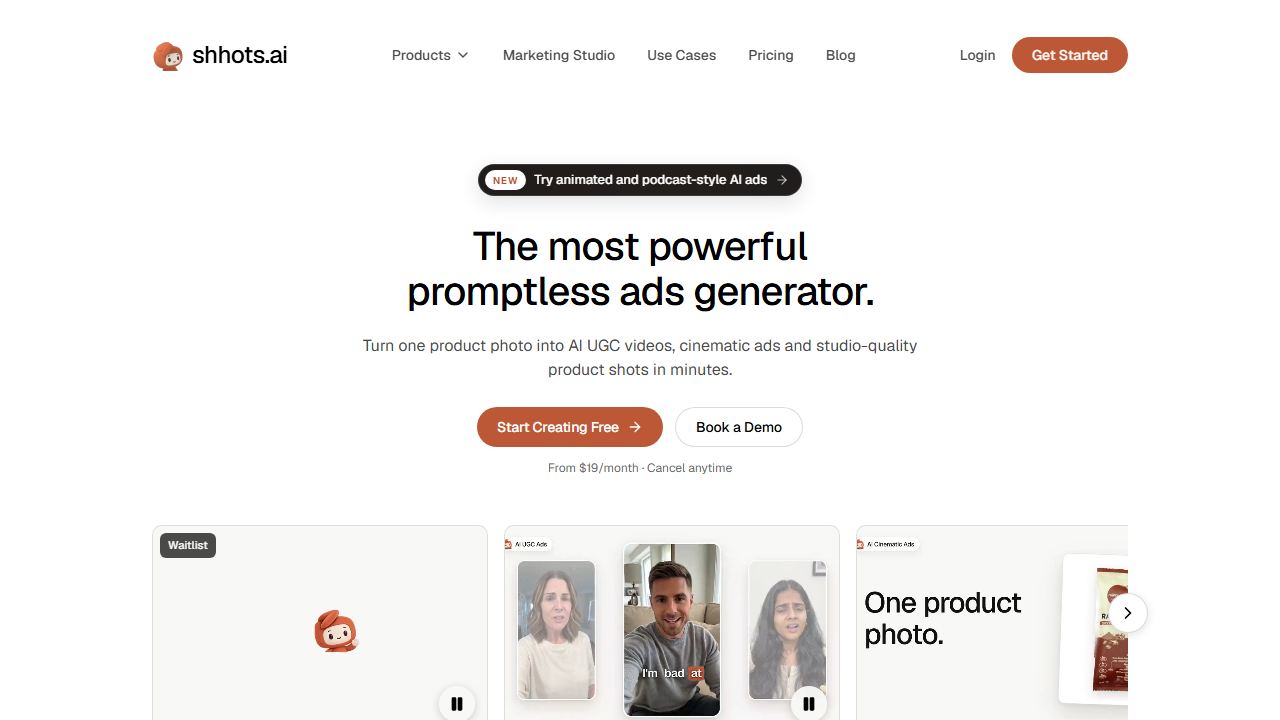
Short answer: Shhots AI is sold on a subscription, so the useful question is not the headline price but which number makes the bill go up: seats, projects or usage. Shhots AI is an ad generator that turns a single product photo into video, UGC-style and static ad variants. Read the plan structure first, the renewal terms second, and the feature list last.
Independent analysis. This page may contain affiliate links.
Read the shape, not the number
Every subscription in this category prices on one of three axes. Per seat: cost grows with people. Per project or workspace: cost grows with clients. Per usage: cost grows with activity. Shhots AI uses plan tiers, which means the axis is capacity rather than consumption, and the practical question is how far the entry tier stretches before it stops being usable.
We deliberately do not quote figures. Vendor prices move, regional pricing differs, and a stale number misleads more than an absent one. The pricing page is the only reliable source, and it should be read on the day you buy.
What the entry tier usually excludes
Entry tiers are built to demonstrate the product, not to run a business on. The exclusions that matter most are export, team access and support level. Export matters because it decides whether leaving is possible. Team access matters because a tool only one person can use creates a dependency. Support level matters because a stalled task at the wrong moment costs more than the plan difference.
Read the comparison table asking one question: which row would stop me shipping this month? That row is your actual minimum tier.
Renewal is the real price
Introductory pricing and standard pricing are frequently different numbers, and the second one arrives quietly after the first term. Put the renewal date in a calendar with the amount, so the decision is made consciously rather than by direct debit.
Annual plans are only a discount if you would have renewed anyway. If there is a real chance you will stop in three months, the monthly plan is cheaper even at a higher rate, because the annual plan converts a decision into a sunk cost.
Cost per output
Divide the monthly plan by the outputs you actually produced last month, not the outputs you intended to produce. Then add correction time at your own rate. The result is the number that compares honestly against doing the task manually or hiring it out.
This is also the number that tells you when to upgrade. Upgrade when the limit is blocking real work, not when the next tier looks more professional.
Hidden line items
Three things sit outside the plan card: overage charges, add-on modules, and the cost of the tools you still need around it. Generated ads still need brand review, and platform ad policy is your responsibility. That is a real cost of ownership, even when it does not appear on an invoice.
Budget for the surrounding stack as well. Shhots AI does not replace your host, your CRM or your payment processor, and plans that assume it does tend to be wrong by the second invoice.
A sane buying sequence
Monthly entry plan, one real task, one month of measurement, then decide. If the numbers work, move to annual on the renewal date, not before. If they do not, cancel and write down why, so the next evaluation starts from evidence instead of memory.
Try Shhots AI on the official site — Open the official site
Read the full Shhots AI review for the complete picture.
FAQ
Does Shhots AI have a free plan?
There is a free entry point in most categories. Check the current plans page for what it caps before relying on it.
Is annual billing cheaper?
Usually per month, but only if you would have renewed anyway. Compare against your realistic usage horizon.
Can I change plans later?
Most vendors allow upgrades immediately and downgrades at renewal. Confirm the mechanics before you depend on them.
What this looks like in practice
Take Shhots AI as a single step rather than a platform. The step is producing enough creative variants to test a product properly, and the measure of success is whether that step now takes less time than it did last month, including the corrections you make afterwards. Teams that write that number down once a month get more from the subscription than teams that judge it by feel.
It also helps to separate the tool from the process around it. Shhots AI is an ad generator that turns a single product photo into video, UGC-style and static ad variants. The process is yours: the input you feed it, the review you apply, and the decision about what happens to the output. When results disappoint, the process is usually the place to look first, because it is cheaper to change than a vendor.
Finally, decide in advance what would make you cancel. A date, a number, a quality threshold. Without a pre-committed exit condition, subscriptions in this category tend to survive on optimism long after the work they were meant to remove has moved somewhere else.
\n