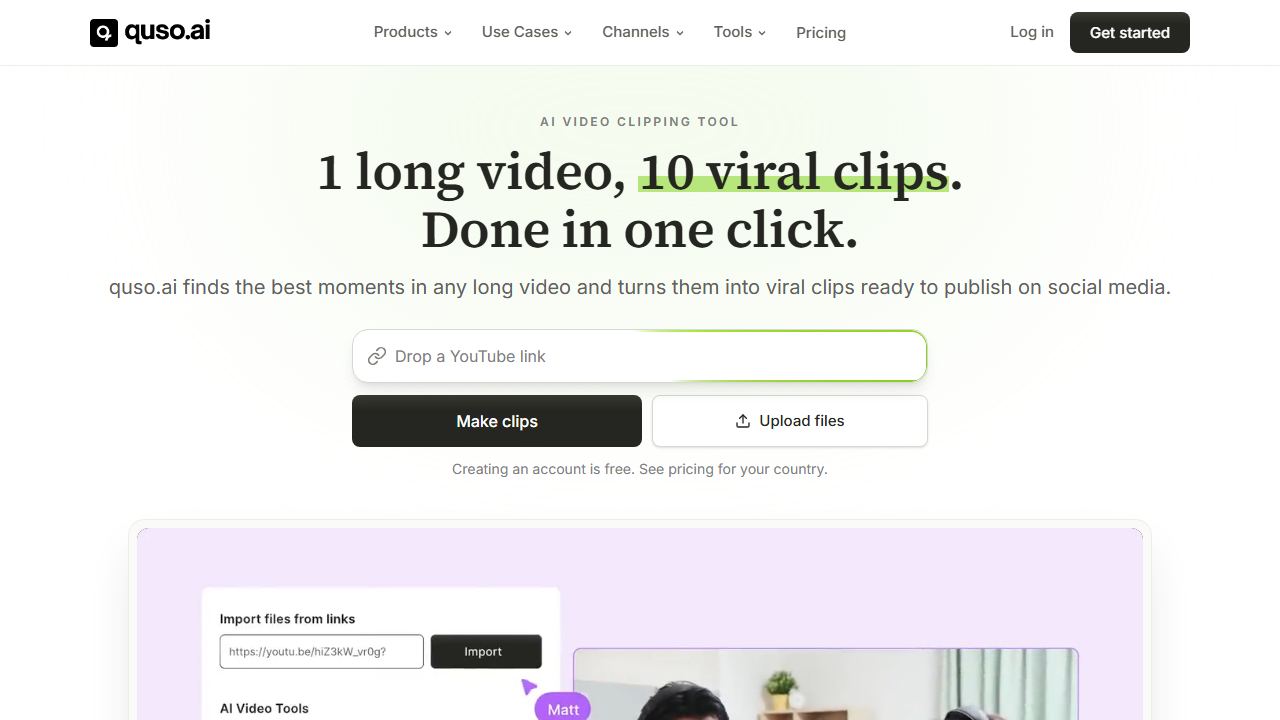
Short answer: agencies should buy quso.ai only when it makes a deliverable repeatable across clients. quso.ai is an AI video tool that turns long videos, podcasts and streams into short captioned clips, then schedules and posts them. If it saves one person an hour, that is a freelancer benefit. If it standardises an output the whole team ships, that is an agency benefit, and only the second one survives a margin review.
Independent analysis. This page may contain affiliate links.
The agency test
Run every tool purchase through one question: does this make a deliverable repeatable by someone who is not the specialist? If yes, it converts salary into process, which is the only way an agency scales without the founder becoming the bottleneck. If no, it is a personal productivity toy with a business bank card.
quso.ai is an AI video tool that turns long videos, podcasts and streams into short captioned clips, then schedules and posts them. Applied to clip production plus distribution in one workflow, it can plausibly meet that test, but only if you write the process down. The tool does not standardise anything on its own.
Where the margin actually leaks
Agency margin leaks in three places: scope that was never written down, revisions that were not capped, and senior time spent on junior work. Tooling can address the third directly and the second indirectly, by making the first draft consistent enough that revision rounds shrink.
It cannot fix undefined scope. If a client can ask for anything, no tool will save the account. Fix the scope language first, then automate the delivery.
Seats, clients and the pricing trap
quso.ai prices on a subscription, and agency plans are often seat-based or client-based. Model the cost per client, not the cost per seat, because the number that matters is whether the retainer still clears your target margin after software.
Automated clip selection still needs a human pass before anything goes out under your name. For an agency that means checking whether client data, client branding and client-specific configuration are supported before you standardise on it.
Rollout without a revolt
Introduce the tool on one account with one owner and a written SOP. Let the team see the output before you make it mandatory. Tools imposed top-down in agencies get used once, badly, and then quietly abandoned while the invoice continues.
Pair it with a review ritual: ten minutes a week where someone shows the actual output and the corrections made. That ritual is what turns a licence into a capability.
Build versus buy
Some agencies build internal tooling for this job. That is justified when the process is your differentiator and when you have engineering capacity that would otherwise be idle. It is a mistake when the process is standard, because you will spend quarters maintaining a worse version of a product you could rent.
quso.ai is the rent option. Judge it on whether the rented version is good enough to ship under your brand, not on whether it is elegant.
Exit terms matter more than features
Ask what export looks like, what happens to client data on cancellation, and how long access survives a downgrade. Agencies get stuck on tools because the client work lives inside them, not because the features are irreplaceable. Choose the vendor you could leave in a week.
Try quso.ai on the official site — Open the official site
Read the full quso.ai review before you commit, and keep the quso.ai alternatives list open in a second tab.
FAQ
Can we resell quso.ai to clients?
Only if the vendor offers a white-label or partner programme. Check the terms directly; most do not allow it by default.
Do we need one seat per client?
Depends on the plan structure. Model cost per client before signing, not after the first invoice.
What is the first SOP to write?
The one for clip production plus distribution in one workflow. Write it as if handing it to a new hire, because that is the standard it has to meet.
What this looks like in practice
Take quso.ai as a single step rather than a platform. The step is clip production plus distribution in one workflow, and the measure of success is whether that step now takes less time than it did last month, including the corrections you make afterwards. Teams that write that number down once a month get more from the subscription than teams that judge it by feel.
It also helps to separate the tool from the process around it. quso.ai is an AI video tool that turns long videos, podcasts and streams into short captioned clips, then schedules and posts them. The process is yours: the input you feed it, the review you apply, and the decision about what happens to the output. When results disappoint, the process is usually the place to look first, because it is cheaper to change than a vendor.
Finally, decide in advance what would make you cancel. A date, a number, a quality threshold. Without a pre-committed exit condition, subscriptions in this category tend to survive on optimism long after the work they were meant to remove has moved somewhere else.
\n