
Home / Automation / Guides / How to set up Make
Tutorial · automation · updated October 7, 2026
How to set up Make: from sign-up to your first working scenario
Make is a visual automation tool, and setting it up is really about getting one scenario to run end to end. This walkthrough takes you from a blank account to a working automation without the usual detours.
Independent analysis. This page may contain affiliate links. Some links here are referral links; if you sign up through one we may earn a reward at no extra cost to you, and it never changes what we recommend. We are an independent publisher and are not affiliated with, endorsed by, or an official partner of any tool mentioned. See our Affiliate Disclosure.
TL;DR
- Make is a visual automation tool: you build a “scenario” from a trigger plus one or more app modules.
- Setup is free to start — create an account, connect one app, and run a two-step scenario.
- You do not need code for the first scenario; you need one clear trigger and one clear action.
- Watch your monthly operation count — that is what a paid plan meters.
- Upgrade only when a real workflow outgrows the free cap.
On this page: What setting up Make means · Before you start · Create your account · Three words that matter · Build a scenario · Test it · Turn it on · When to upgrade · Common mistakes · Where this fits
What setting up Make actually means
Make connects apps so that work happens without you. Unlike a simple “if this then that” tool, Make is built around scenarios: a visual canvas where a trigger starts a run and one or more modules act on the data.
So “setting up Make” is three milestones rather than one install: create an account, learn the scenario editor, and get a single automation running correctly. Templates and advanced modules come later.
Before you start
- An email address you can confirm right away.
- One app you already use that can act as a trigger — a form, a spreadsheet, a store or an inbox.
- A one-sentence job description: “when this happens, do that”.
- A few minutes to run the scenario by hand once.

Step 1 — Create your account
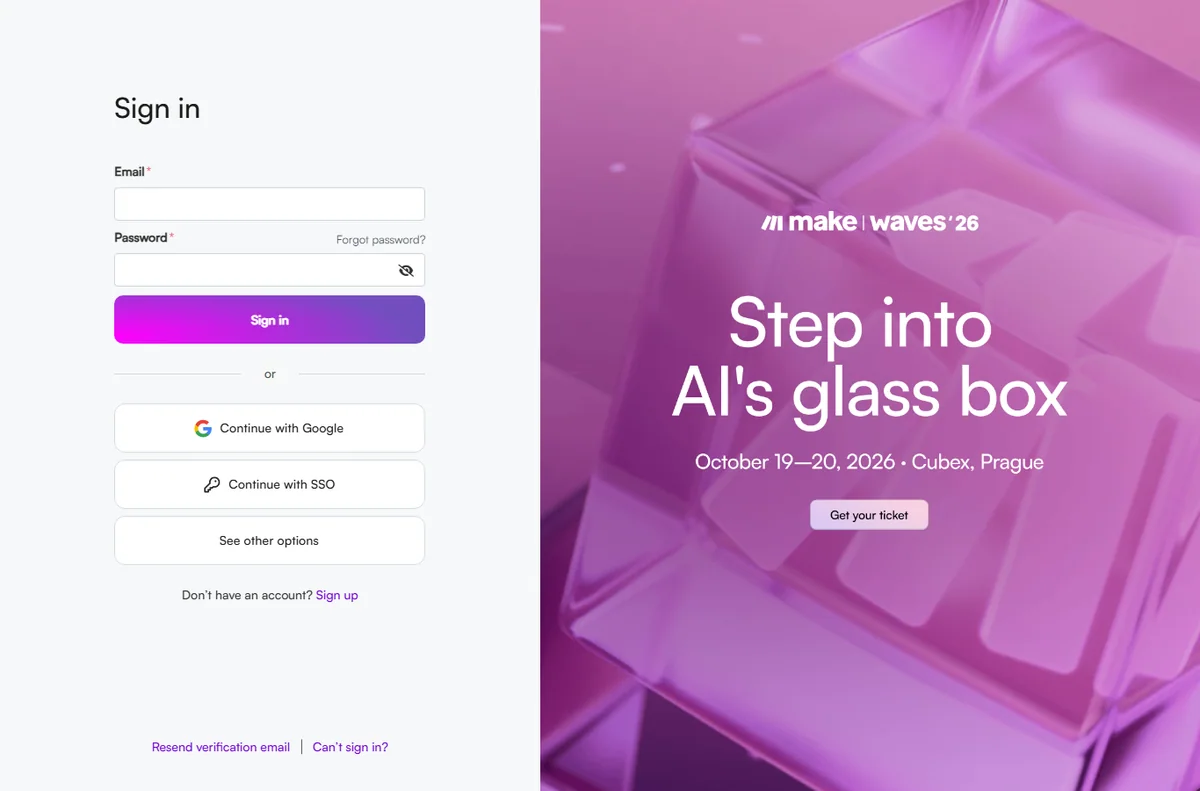
Sign up on the vendor’s site and confirm the email. You land in a dashboard that lists organizations, scenarios and templates — not in the editor, which surprises people who expect to start building immediately.
Begin on the free tier. It is enough to learn on, but it meters a monthly operation cap, so treat it as a sandbox rather than production.
Step 2 — Learn the three words that carry the meaning
- Trigger — the event that starts a scenario (a new form entry, a new row, a new order).
- Module — a step that does one job, such as creating a contact or sending a message.
- Operation — one unit of work a module consumes; this is what your plan meters.

Step 3 — Build a two-step scenario
- Open Scenarios and choose “Create a new scenario” rather than a template, so you learn the parts.
- Click the first node, pick your trigger app and event, then create a connection (authorise the app once).
- Add the second node and pick the action: for example, “Create a row” in a spreadsheet or “Send a message”.
- Map the fields — drag the trigger’s output into the action’s input so the data flows across.
Step 4 — Test before you trust it
Use the run-once control to pull sample data through the scenario. Read the input and output of each module; the first failure is almost always a mis-mapped field or an authorisation that expired.
Step 5 — Turn it on and watch the first runs
Once a manual run succeeds, set the schedule or webhook and switch the scenario on. Watch the first few executions rather than assuming they are fine — especially the first time real traffic hits it.

Step 6 — Know when to upgrade
Upgrade when a genuine workflow outgrows the free operation cap, not before. Estimate your monthly operations from real volume, then pick the smallest paid tier that covers it comfortably. We deliberately do not quote prices — vendors change tiers and caps often, so confirm current figures on the vendor’s own pricing page.
Common setup mistakes
| Mistake | Why it hurts | Fix |
|---|---|---|
| Starting from a complex template | You inherit logic you do not understand | Build one simple scenario first |
| Ignoring the operation count | The free cap is hit mid-month | Model monthly volume early |
| No error handling | A silent failure breaks the flow | Add an error handler or fallback path |
| Testing with live data only | Failures are hard to reproduce | Use sample data, then a live run |
| Turning on before a manual run | The first real execution fails | Always run once by hand |

Where this fits in your wider stack
If you are still choosing a platform, start with the business automation hub and the independent Make review. For cost, see the Make pricing guide, and if you are weighing platforms, the Make vs n8n comparison. Teams that need the broadest connector catalogue often compare against the best workflow automation tools.
Frequently asked
How long does it take to set up Make?
The account and first simple scenario take roughly 20–40 minutes for a first-timer. Multi-step scenarios with branching take longer because they add concepts, not because the setup itself is long.
Do I need to know how to code?
No. The first scenarios are built by clicking modules and mapping fields. Code only enters if you use a code module for a transformation the built-in functions cannot do.
Is the free plan enough to start?
It is enough to learn and to run low-volume workflows. It meters a monthly operation cap, so busy automations reach it quickly. Check the current cap on the vendor’s pricing page.
What is an operation, exactly?
An operation is one unit of work a module performs during a run. A scenario with three modules that runs once typically consumes three operations. That is why volume matters more than the number of scenarios.
Should I use a template or build from scratch?
Build your first scenario from scratch so you understand triggers and modules, then use templates once you can read what they do. Templates are shortcuts, not a substitute for understanding.
Build one scenario, then judge the tool
Count your steps first, then prototype on the free tier.
Referral link — we may earn a reward if you sign up, at no extra cost to you. We are an independent publisher. See our Affiliate Disclosure.