
Home / Reviews
Reviews & methodology · updated October 5, 2026
How ICode reviews software — and every review we publish
Quick answer. In short: the best software for small business for a small business balance price, ease of use and support. For most teams the category leader is a solid starting point, but a second option often fits specific workflows better. Compare two or three options below before you commit.
A review is only worth reading if you know how it was produced. This hub sets out our evaluation criteria, our process, what we refuse to do, and a live index of every review ICode has published.
On this page: Criteria · Our process · What we don’t do · Published reviews · What we choose to review
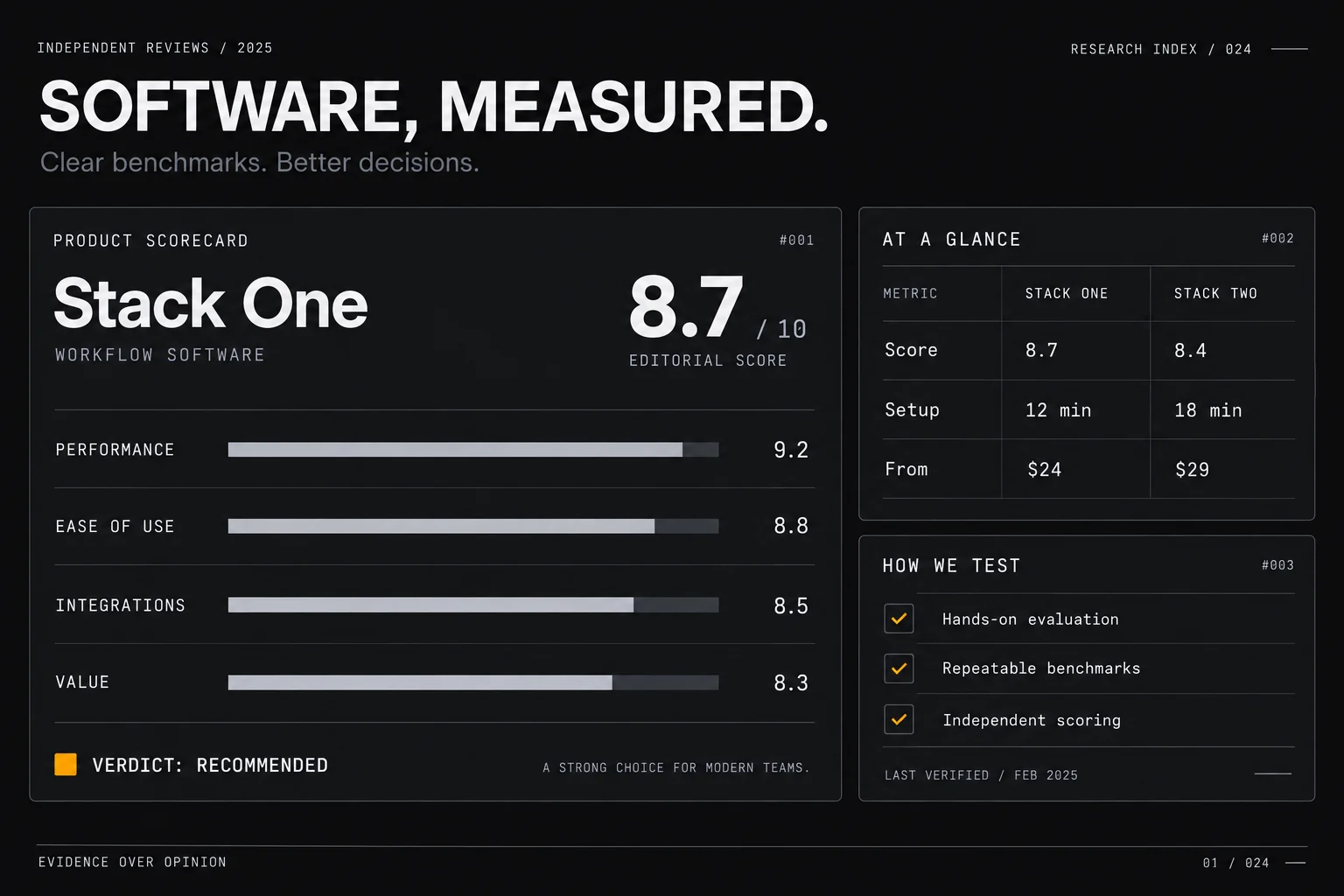
Affiliate disclosure: some reviews and guides on ICode contain affiliate links, and we may earn a commission if you sign up through them — at no extra cost to you. It never changes our assessment, our criteria or the order of any list. Reviews are written independently of any commercial relationship. See our Affiliate Disclosure.
The six criteria we judge every product on
We use the same framework across categories so that a review of an automation tool and a review of a payment service can at least be read in the same terms. Each review says which criteria mattered most for that product’s job.
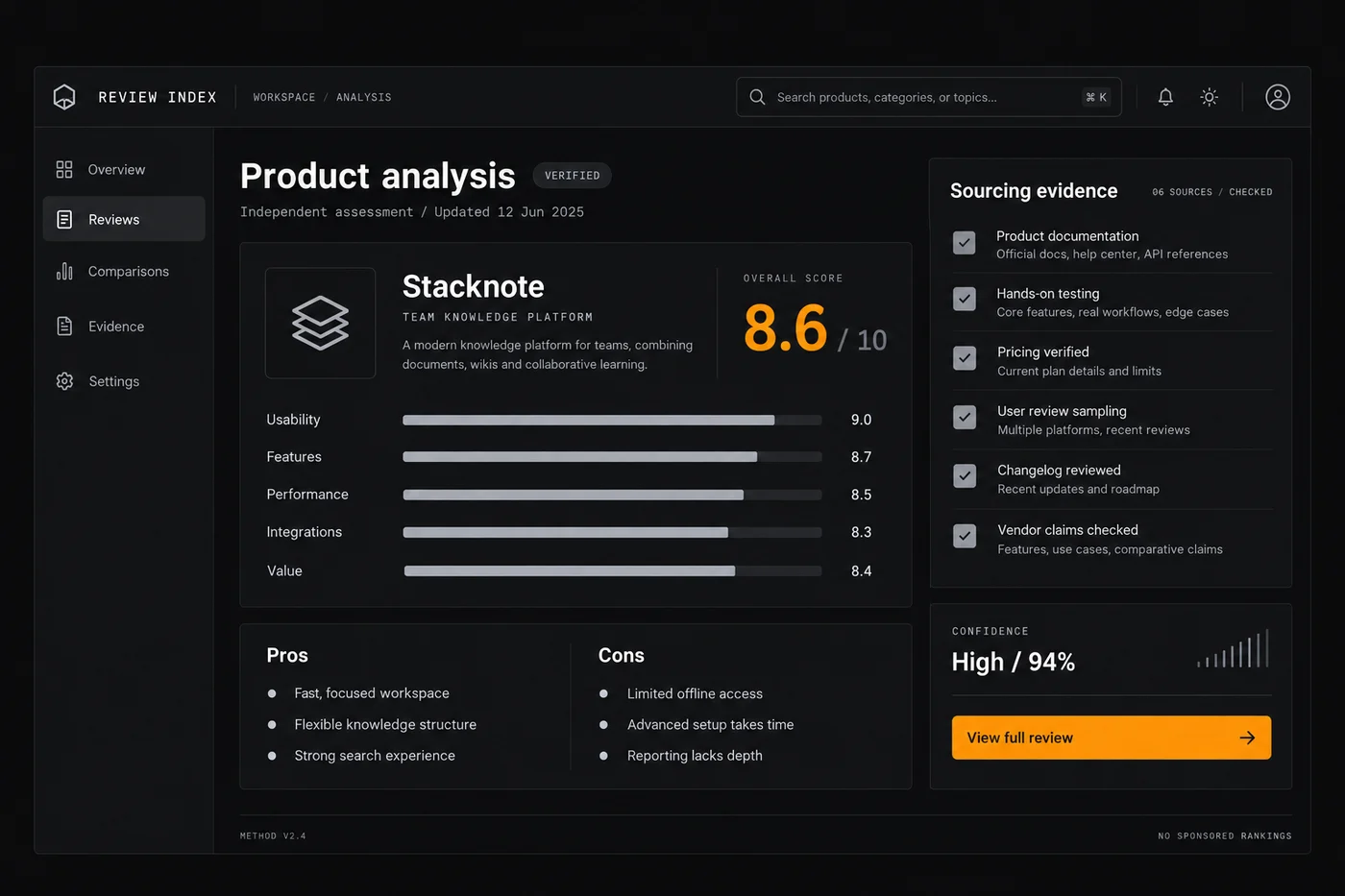
- Price & value. What you actually get per dollar, and how costs behave as your usage grows — not just the entry-tier headline price.
- Core features. Whether the product does its main job well, assessed against the tasks users buy it for.
- Ease of use. How quickly a new user reaches a real result, and how much training the tool assumes.
- Integrations. Whether it connects to the systems most small teams already run, and on which plan.
- Support & limits. The ceilings you will hit, and the quality of help when something goes wrong.
- Transparency. Whether pricing, limits and terms are stated clearly enough that a buyer can predict the cost.
Where a review includes a numeric score, that score is our own editorial assessment against these criteria — not a user-survey average and not a vendor-provided rating. We say so on the page where it appears.
How a review is produced
Our process is deliberately written down, so you can hold us to it — and so we can correct ourselves when it slips.
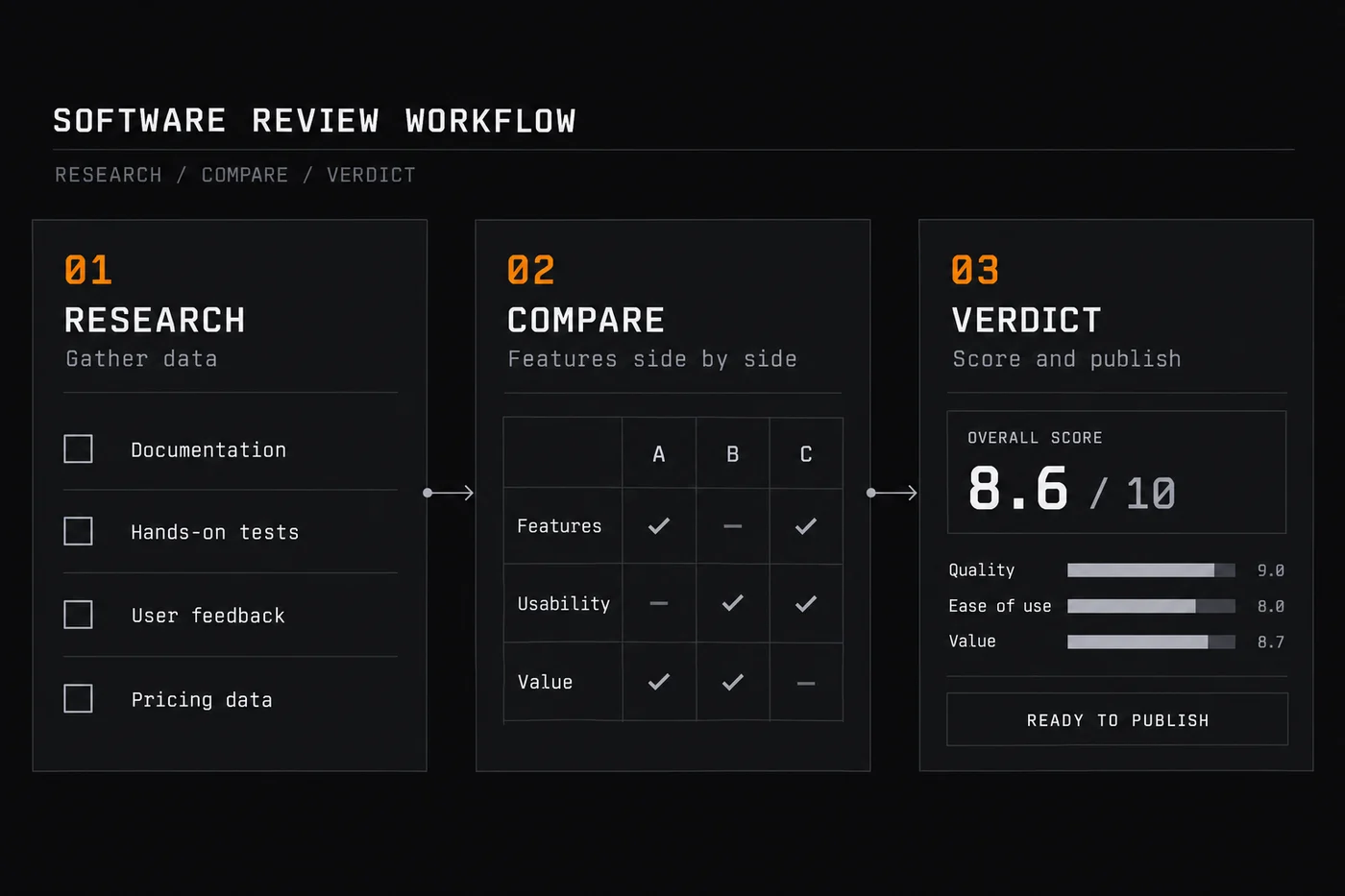
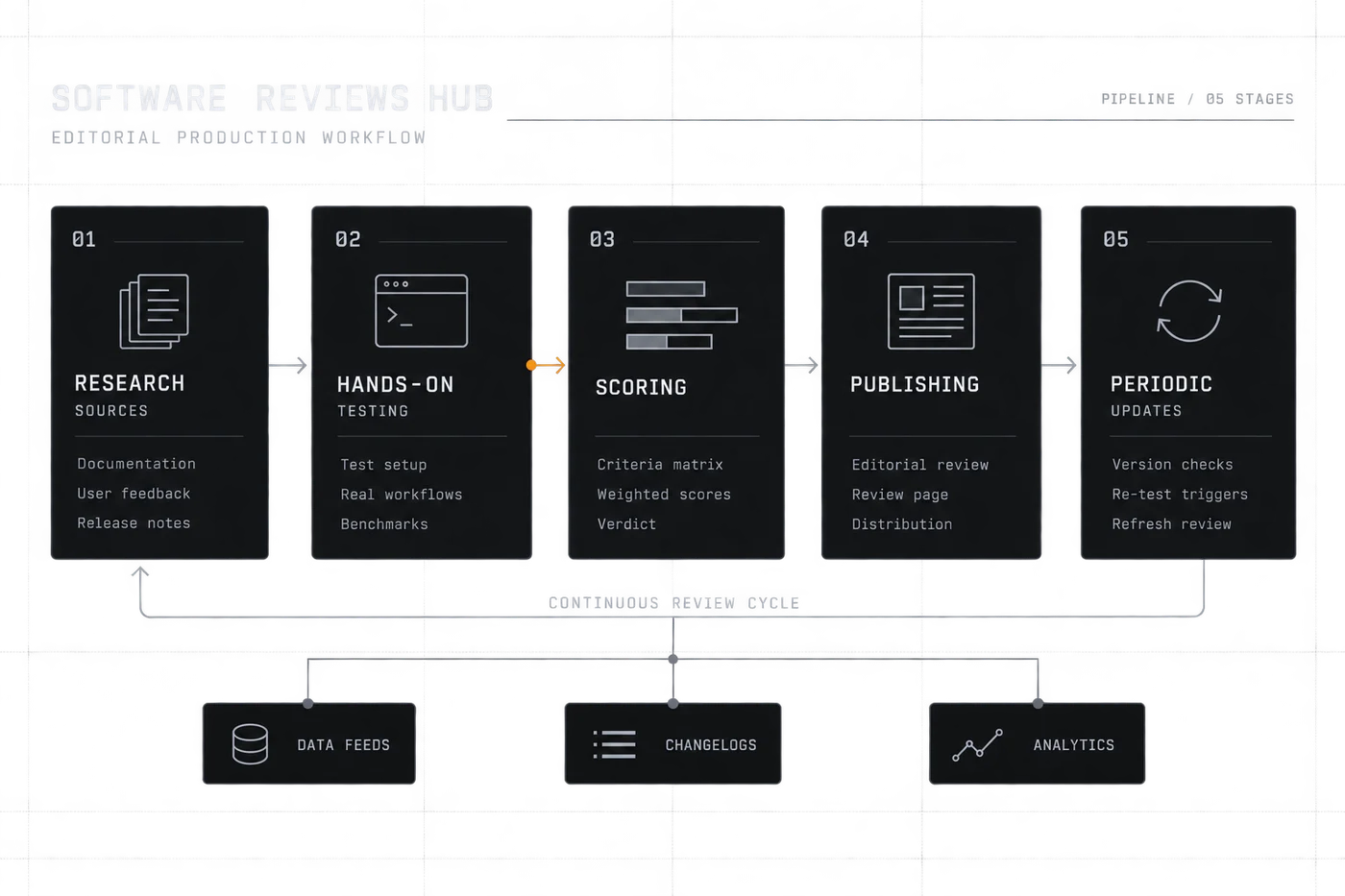
01 — Research
We start from the vendor’s own pricing, feature and terms pages as primary sources, then note what is unclear or ambiguous. Vendor-reported figures — user counts, uptime, performance claims — are labelled as vendor-reported, not restated as our own finding.
02 — Compare
Every review names who the closest alternatives are and why someone might choose them instead. If a product is not the best choice for a reader’s situation, the review says so and points elsewhere — including to a competitor.
03 — Evaluate
We score against the six criteria above and write pros and cons in the same weight, including the real drawbacks. We do not claim hands-on testing we have not performed; where we have not run a test, we say what our assessment is based on.
04 — Update
Pricing and features change, so reviews carry a last-updated date and are revisited. If a claim no longer holds, we change it; we do not change dates to imply freshness that did not happen.
What we refuse to do
These limits are the reason to trust a review more than a marketing page. They are not aspirational; they are rules we hold ourselves to.
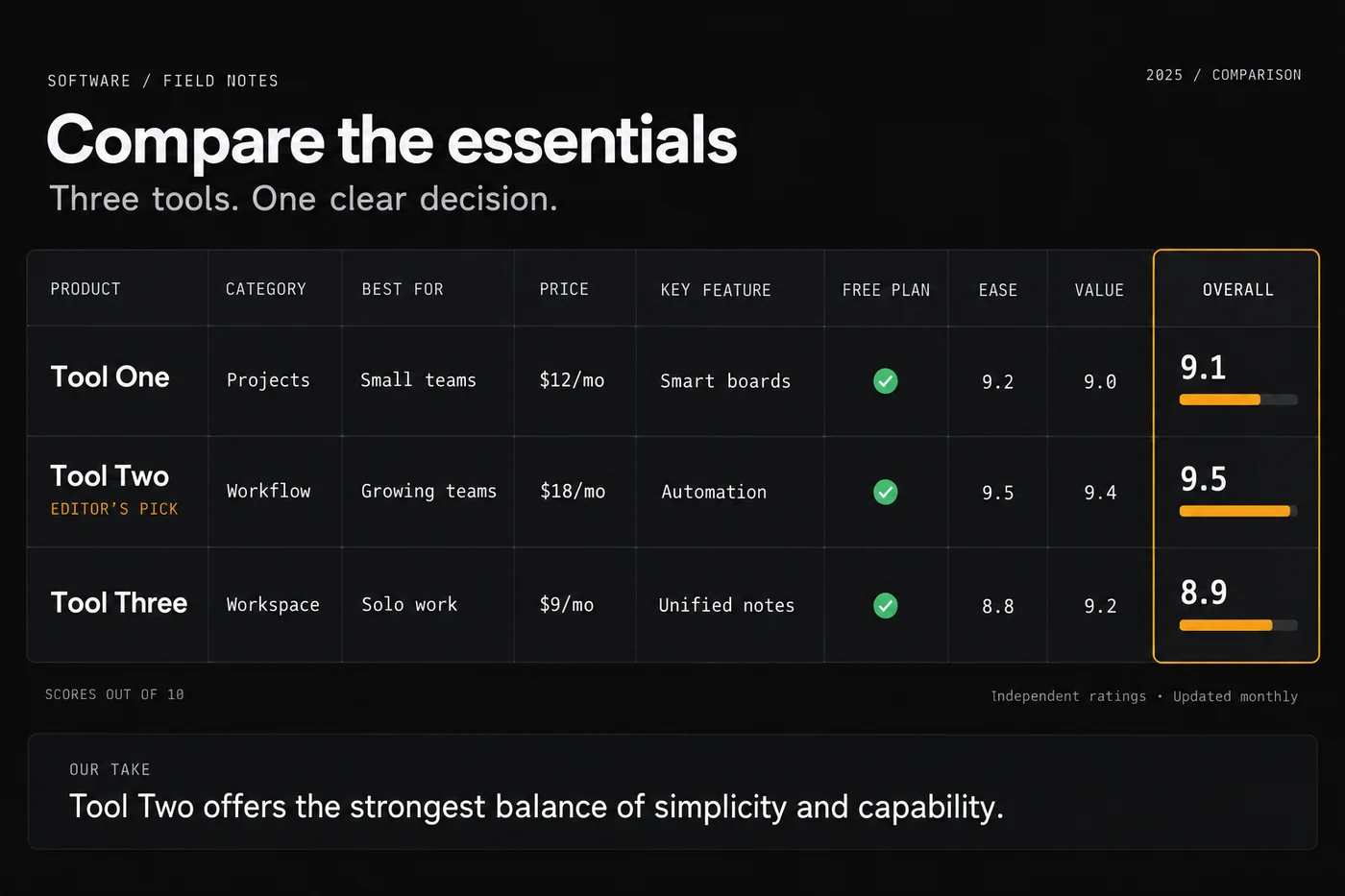
- No paid placement or paid rankings. Vendors cannot buy a position, a score or a positive line.
- No fabricated testing. We do not claim to have used a product if we have not, and we do not invent test results, benchmarks or screenshots.
- No fake ratings or reviews. We do not manufacture user reviews, aggregate stars or testimonials.
- No invented prices or discounts. If a number is unverified, we point you to the vendor’s current page instead of quoting it as fact.
- No affiliate-driven conclusions. Whether a page earns a commission never decides whether a product is recommended.
Reviews we have published
Our review library is small on purpose: we publish when a product is worth a thorough assessment, not to fill a category. Each entry links to the full review.
| Product | Category | Status | Read |
|---|---|---|---|
| Make | No-code workflow automation | Published · updated October 2026 | Make review |
| systeme.io | All-in-one funnels, email & courses | Published · updated October 5, 2026 | systeme.io review |
| Wise | Cross-border & multi-currency accounts | In preparation | Wise review |
The Wise review sits inside our payments & money-transfer hub. The Make review belongs to the automation hub, and the systeme.io review sits across funnel builders, email marketing and course platforms.
How we choose what to review
We cannot review everything, so here is the filter we use. It is deliberately centred on the reader’s decision, not on what is easiest to monetise.
- Relevant to small teams. The product solves a problem our audience actually has.
- A genuinely hard decision. If the choice is obvious, a full review adds little; we cover it in a hub instead.
- Enough verifiable public information. We can ground the review in the vendor’s own pricing, feature and terms pages.
- A real alternative set. There are credible competitors worth naming, so the review can help you choose rather than just describe.
- Worth maintaining. We can keep it current as pricing and features change.
If a product does not clear this filter, we would rather expand an existing guide than publish a thin review. See the guides hub for the categories where we concentrate our coverage.
Independence, corrections and disclosure

ICode is an independent publisher. We are not affiliated with, endorsed by, or an official partner of any vendor we write about, and we do not present ourselves as such. Where a page contains affiliate links, the disclosure appears near the top of that page as well as in our global Affiliate Disclosure.
If you spot something out of date or wrong, tell us and we will check it. Our About page explains how corrections are handled, and our contact page is the fastest route to reach us.
Judge the review by the method
Criteria, process and corrections are all published above — hold us to them. Every review links back to this page so the method is never hidden.
Related
Frequently asked
How does ICode review software?
We use a criteria-based method: we define what matters for the category, compare each product on those criteria using vendor documentation and hands-on checks, and label which figures are vendor-supplied.
Are ICode reviews independent?
Yes – rankings are based on our criteria, not on commission. Some links are affiliate links that earn a small commission at no extra cost to you, and they never change a verdict.
How often are reviews updated?
We revise reviews when pricing, features or policies change and date each page so you can see when it was last checked.
How do I request a correction?
Contact us through the contact page with the page URL and the detail in question; we review corrections and update pages when warranted.
People also ask
What are the best software for small business?
In short: the best software for small business for a small business balance price, ease of use and support. For most teams the category leader is a solid starting point, but a second option often fits specific workflows better. Compare two or three options below before you commit.
What are the best software for small business for small business?
The best software for small business for a small business are usually the ones with predictable pricing and a clear free or low-cost entry point. For most teams the category leader is a good starting point; compare two or three options before you commit.
How do I choose software for small business?
Start from your workflow and budget, not the feature list. List your must-have jobs, test the top two tools on a free plan, and check how pricing scales as you grow. Our hub pages break each option down by use case.
Are there free options?
Several software for small business offer a free tier or a trial. Free plans usually cap usage or seats, so use them to validate fit, then upgrade when a limit starts to cost you time.